By Thet Mon Tun
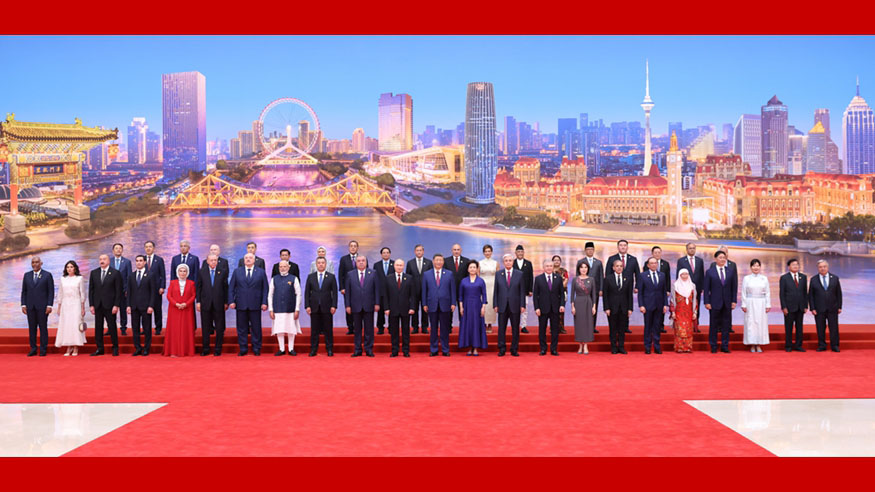
CHINESE President Xi Jinping exposed his latest premise in the recent Shanghai Cooperation Organization Plus Meeting, known as the “Global Governance Initiative (GGI)” for safeguarding world peace with the Shanghai Spirit – mutual trust, solidarity and respect. Given the international turmoil, crises, geopolitical tensions and institutional gaps in global governance, the GGI suggests five keys to realign the international order, which is currently malfunctioning.
The original commitment to peace with UN values is tested.
It has been 80 years since the United Nations was established to shape the world with its core values of equality, justice and mutual respect. During this eight-decade period, it is true that the world has flourished with prosperity and peace brought by the United Nations. People of various nations have witnessed rewards and incentives that the world gained as a result of the cooperation of nations multilaterally over the years.
Yet today, the United Nations and multilateralism are being challenged. Aggressive major power countries and their allies intentionally ignore the important UN resolutions; tanks have passed through the UN posts; shells have crossed the blue line; and bombs have hit the UN watchtower. “Peace is never abstract – it stands on the edge of life and death.”
Furthermore, byproducts and side effects were produced in the mechanism of the rules-based international order. In this matter, neocolonialism, neo-conservatism and Cold-War mentality emerged as secondary phenomena in the post-World War II international order. When those unexpected, flawed ideologies are getting stronger in the years that follow, the peaceful post-World War II global order will be disrupted. Major countries place themselves in the position of global outliers by shaping the world with unipolar power. The concept of Manifest Destiny infected the equal-based multilateralism.
Thus, it becomes the responsibility of all nations for humanity to maintain the original commitment to peace and to improve the global governance system in line with the principles of the United Nations.
Epoch-making for fairer and more equitable international relations
Current global geopolitics has entered into turbulence and hostility. Without a doubt, nations are at the crossroads between unity and division, cooperation and confrontation, and zero-sum and win-win objectives. In response to such dysfunction of the global governance system, China calls for adhering to sovereign equality, abiding by the international rule of law, practising multilateralism, a people-centred approach, and taking real actions.
Keywords of the Global Governance Initiative – sovereignty, international rule of law, multilateralism, people-centred approach and real actions – are deemed to be the right momenta in reshaping the global order into a fairer, more reasonable and more pragmatic one with advocacies for the Global South. Peace needs to be formulated without undermining the national interests of the nations.
The Global Governance Initiative encourages cooperation and integrity by upholding multilateralism to defend international justice for building a synergetic shared future. In addition, the announcement of the newly proposed initiative at the SCO+ Meeting is the symbolic strategy of being embedded with the Shanghai Spirit from Amazon to the Mekong. That shows the solidarity of Eurasia and Africa; in other words, the power of the Global South.
This latest initiative does not intend to build a parallel power towards the United Nations, but to restore the original inspirations of founding the United Nations. In fact, the United Nations is the place where countries can resolve issues on an equal basis, and where dialogue can be put at the forefront instead of waging wars in resolving disputes. “War cannot solve problems and sanctions will only complicate them,” – Wang Yi.
Myanmar-China’s comprehensive strategic partnership supports GGI
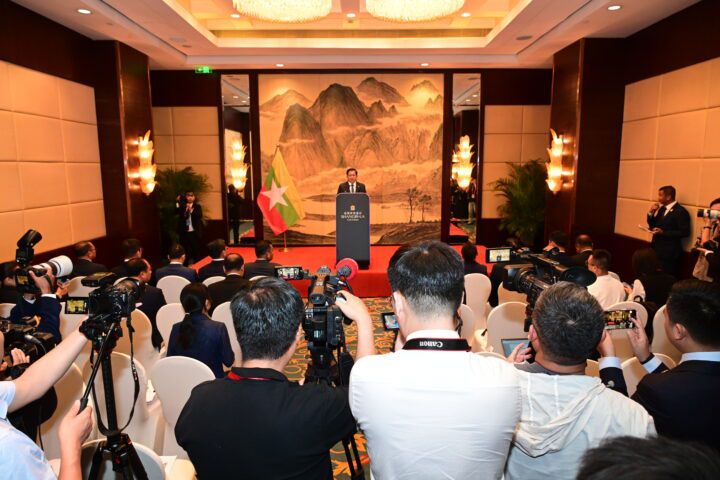
Myanmar fully supports the Global Governance Initiative and its aim, Senior General Min Aung Hlaing asserted during his recent visit to Chengdu, following his days in Tianjin, Beijing, and Harbin of China. The Senior General noted: “Among the various sizes of countries with developed, developing or poor statuses, some major power countries are exerting coercive pressures on other countries both with equal strength and lesser strength by means of politically, economically, financially and militarily. President Xi highlighted this fact and suggested that reform is required.”
Time flies. This year marks the 75th anniversary of diplomatic relations between the two countries. Myanmar-China bilateral ties have reached their highest this time after being tested over time, turbulence, experiences, and propaganda strategy. Bound by history, the two intertwined nations are now committed to formulating a comprehensive strategic partnership in various sectors, which somehow upholds the consolidation of the Chinese proposed initiatives: Belt and Road Initiative, Global Development Initiative, Global Security Initiative, Global Civilization Initiative, and now the Global Governance Initiative.
What is more, Senior General Min Aung Hlaing also pledged during his recent trip to China that his administration will prioritize formulating a strategic partnership with China.
Since the two countries were colonized in bygone history, we have learned very well about the bitterness of being suppressed; the hostility of invasion; the atrocities of the invaders; and the sacrifices of many souls in fighting to get back the sovereignty. Standing shoulder to shoulder, both countries reject any form of hegemonism, neocolonialism and neo-conservatism.
Myanmar and China will work side by side in reaffirming the UN-centred international system by promoting an equal and orderly multipolar world. Multipolarity is a fact. It emboldens an inclusive global governance system by uplifting the voices of the South countries.
Constructor Versus Destructor
Instead of waging coercive tactics, sympathy and love for mankind should be placed. Instead of engaging in forcible diplomacy, dialogue should be upheld. Instead of monopolizing the global dominance, mutual trust and mutual respect should be strengthened. Instead of bullying others, a few major countries should collaborate and coordinate. Fruitful prosperity should be shared among nations across different continents; there must not no forgotten continent or country. As time goes by, unilateralism will end by itself. Only the milestones of humanity made by a constructive and people-centred approach will long exist, while destructive motives for mankind will definitely fail in the end.