ACTING President of the Republic of the Union of Myanmar, Chairman of the State Security and Peace Commission of the Republic of the Union of Myanmar, Senior General Min Aung Hlaing paid working visits to the Russian Federation at the invitation of President of the Russian Federation Vladimir Vladimirovich Putin and to the Republic of Kazakhstan at the invitation of President of the Republic of Kazakhstan Mr Kassym-Jomart Tokayev. Yesterday morning, the high-level Myanmar delegation left the Astana Airport of Kazakhstan, and the delegation members were seen off at the airport by Mr Roman Sklyar, First Deputy Prime Minister of Kazakhstan, U Thit Linn Ohn, Myanmar Ambassador to the Russian Federation, and officials.
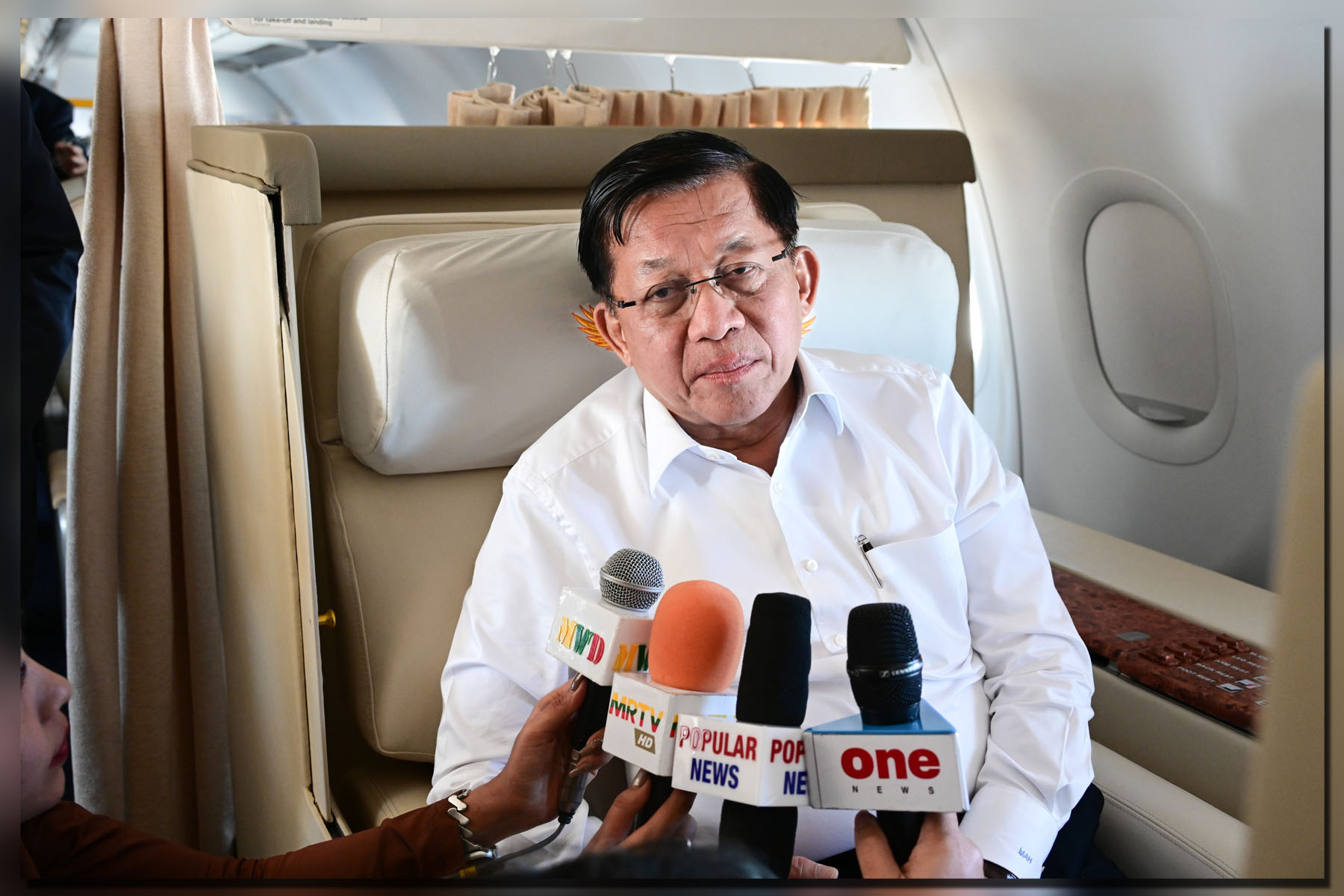
On his way back to Myanmar, the Acting President and SSPC Chairman of the Republic of the Union of Myanmar replied to queries raised by the media aboard the aircraft and the full text of the question and answer session is presented as follows: —
Q: As the Acting President, by attending the “World Atomic Week Forum” held at the Atom Museum in Moscow, the Russian Federation, what benefits have we gained for Myanmar and its citizens? I would like to know in which sectors these benefits for the State can be effectively realized.
A: I attended the World Atomic Week Forum in Moscow at the invitation of President Putin. At the forum, I had the opportunity to meet with President Putin, the Belarusian President, the Prime Ministers of Armenia and Ethiopia, other leaders, and the Director General of the IAEA. We were able to discuss areas for potential bilateral cooperation. This was a unique forum, primarily focused on exchanging views regarding the peaceful use of nuclear energy. As a member country of the IAEA, Myanmar also participated in discussions on how nuclear energy can be used for human-beneficial purposes. The benefits we gained from attending the forum are considerable.
Q: During the trips to the Russian Federation and the Republic of Kazakhstan, it is observed that the Acting President of the Republic of the Union of Myanmar held several meetings and discussions. Please explain what benefits or positive outcomes were achieved for our country through these discussions.
A: I was able to have a separate meeting with President Putin. Such a meeting was held in March. Based on the outcomes of that meeting, we reviewed the progress and assessed the situation. Both sides evaluated the results and discussed how to further expand areas of cooperation. Initially, our discussions focused on trade and investment, energy, transportation, defence cooperation, as well as collaboration in the space and nuclear sectors.
Similarly, upon arriving in Kazakhstan, I held a meeting and discussions with the President of Kazakhstan. This was our second discussion, the first having taken place in March. Based on the outcomes of the initial meeting, we discussed which sectors to further expand, where to make investments in Myanmar, and how Myanmar’s products could be used to produce value-added goods in Kazakhstan. We also explored collaboration in science and technology, as well as urban development sectors. I can say that the discussions produced very positive results.
Q: I know you are the first-ever Head of State of Myanmar, as the President paying a visit to Kazakhstan. I would like to know whether, in the future, cooperation and investment between Myanmar and Kazakhstan can be further expanded and strengthened.
A: As I mentioned earlier, this was my second meeting with the President of Kazakhstan. Myanmar and Kazakhstan have maintained diplomatic relations for 26 years. Diplomatic ties were established on 26 September 1999, and I arrived there on 27 September, one day after the date. So, it coincided with the 26th anniversary, which was a special occasion. The Kazakh President also highlighted this significance. This was the first visit by a Myanmar head of state to Kazakhstan, marking a new step in bilateral relations. As I mentioned earlier, we were able to discuss areas of economic cooperation, investment measures, collaboration in science and technology, education, and healthcare. Kazakhstan is a developed country, rich in natural resources, especially underground resources such as oil and natural gas, as well as copper, gold, chromium, and iron. Kazakhstan is one of the world’s top exporting countries. It is also engaged in both agriculture and livestock activities. Their wheat ranks among the best globally, based on sample testing. Similarly, Myanmar’s main export product is Pawsan rice, which has attracted considerable interest. Discussions were held on how Myanmar could export this product. Overall, the opportunity to meet and engage revealed that both countries are eager to expand bilateral cooperation across various sectors with enthusiasm and commitment.
Q: When building a modern and developed nation, the Head of State and government are implementing processes on multiple fronts. As citizens, we would like to understand how we can collectively cooperate and contribute to ensure the success of these initiatives.
A: The key point is that we need to make efforts on multiple fronts. On the other hand, political differences exist, but these should be approached with a broad perspective to benefit the Union. Some of the remarks being made have certain weaknesses. Specifically, some statements are based on political, religious, or ethnic viewpoints. We believe it would be better if these discussions were conducted with a wider and more inclusive perspective. At the same time, our own efforts are also required. These efforts involve two main areas. First is education. It can’t be denied that the current situation in the country shows weaknesses in education. The second area is production and industrial work. These two areas must be actively pursued. As I mentioned earlier, most of our exports are raw materials, such as oil, natural gas, and forest products. However, the proportion of goods that are processed and exported after production is still very low. I highlight this as a limitation in our current economic approach.
Therefore, we need to utilize the water, land, forests, and mountains to develop production industries. That is a strong approach. Simply exporting raw materials, as we currently do, is not a robust strategy. A strong industry requires active production. During my visit to Kazakhstan, I noticed that in their GDP, there are three main sectors: agriculture, industry, and services. Their agricultural sector is relatively small, while the industrial and service sectors are considerably larger. Agriculture accounts for only about 20 per cent of GDP. I believe they are aware of this and actively support agricultural production. In their country, if someone wants to work and invest, permission is granted quickly within a short timeframe. Similarly, in our country, people need to take a strong interest in production. Instead of focusing primarily on buying and selling raw materials, we should first develop production. Through production, the country can generate revenue. I want to emphasize that the State should pay attention to this matter.
Q: This trip was a successful one, and I feel proud and pleased to have witnessed the tireless efforts you made day and night. As the President, what else would you like to say regarding this trip?
A: It was indeed a successful trip. During our visit, we were able to sign a cooperation agreement on nuclear matters. Furthermore, we signed another cooperation agreement related to space, marking new steps forward for our country. Kazakhstan, which officially gained independence after 1991, has a long historical foundation. By effectively utilizing its human and natural resources, the country’s current development is very evident. Astana, the capital city, is slightly ahead of Nay Pyi Taw in terms of urban development. The city’s planning and layout provide valuable lessons in construction and urban planning, which we were able to observe closely. This experience also offered insights into how our country could approach urban development, and I consider that an important success of the trip.