By Maung Maung Aye
SEVEN years ago, I received an invitation by phone from a friend who lived in North Dagon. He suggested I should visit his home near Phyo Sabei Bus stop when I have free time. The opportunity was offered to me on 4 January.
That morning, I got up, cleaned myself, changed into fine clothes, and had fried rice prepared by my mother. Then, I set out to see him.
When I got home, he greeted me warmly and invited me to sit there for a while. Soon, he took me to a nearby tea-house. In it, we chatted friendly over steaming tea for half an hour. He then suggested that we should visit the Wutkywaetawpyay Buddha Image near the Ngamoeyeik Bridge, North Dagon, across North Okkalapa, because my visit coincided with the annual Buddha Pujaniya ပွဲတော် (the festival of paying homage to the Buddha). I agreed willingly to it.
The cars were held up at the traffic lights. Thus, we hurriedly crossed the junction between Bo Hmu Bahtoo Road and U Visara Road. Immediately after passing the Free Funeral Services Society, founded by U Kyaw Thu, we saw the Gandayon Bus Stop, where some passengers were waiting for the buses. Across it, a driving training course had been conducted. I saw the Nagayon Buddha image in a lake and some glittering pagodas near the Ngamoeyeik Bridge. We espied the Bridge, which is a vital link between North Dagon and North Okkala. Soon, we walked into a serene street on the left side about 100 yards until the bridge. There stood many missionary buildings, monasteries adjoining the wide fields on either side of the street.
We reached the precincts of the Wutkywaetawpyay Buddha Image at around 11:30 am. At the entrance, a signboard reading “Yanaungmyin”, meaning “victory over all enemies”, welcomed us. We continued walking and soon, we saw a statue of Bodhisatta (Newly-born Prince Siddhattha), standing with his index finger raised in proclamation. I noticed in the precincts many Buddha images carved in the ancient Bagan Style and three-storeyed monastic buildings. Especially, the most prominent is the Alotawpyae Buddha image, a replica of the original Bagan masterpiece, and other images, such as a reclining Buddha, reflect Myanmar's rich cultural heritage of Myanmar.
After paying respects to several sacred images, my friend led me to the Aung Pyaedipa religious edifice. Although it was a two-storey building, it was very high. So, there was an accessible staircase leading upstairs. We worshipped a Buddha image, offering flowers and joss sticks. I also donated money to a monk who sojourned there. Standing in the airy verandah of the two-storeyed building, I enjoyed the natural scenes such as clouds, clumps of trees, spires of pagodas, multi-tiered roofs, etc. I also espied ' The white-washed Sabbhunyu Stupa ' donated by a nun, located in Kyaukyedwin Ward.
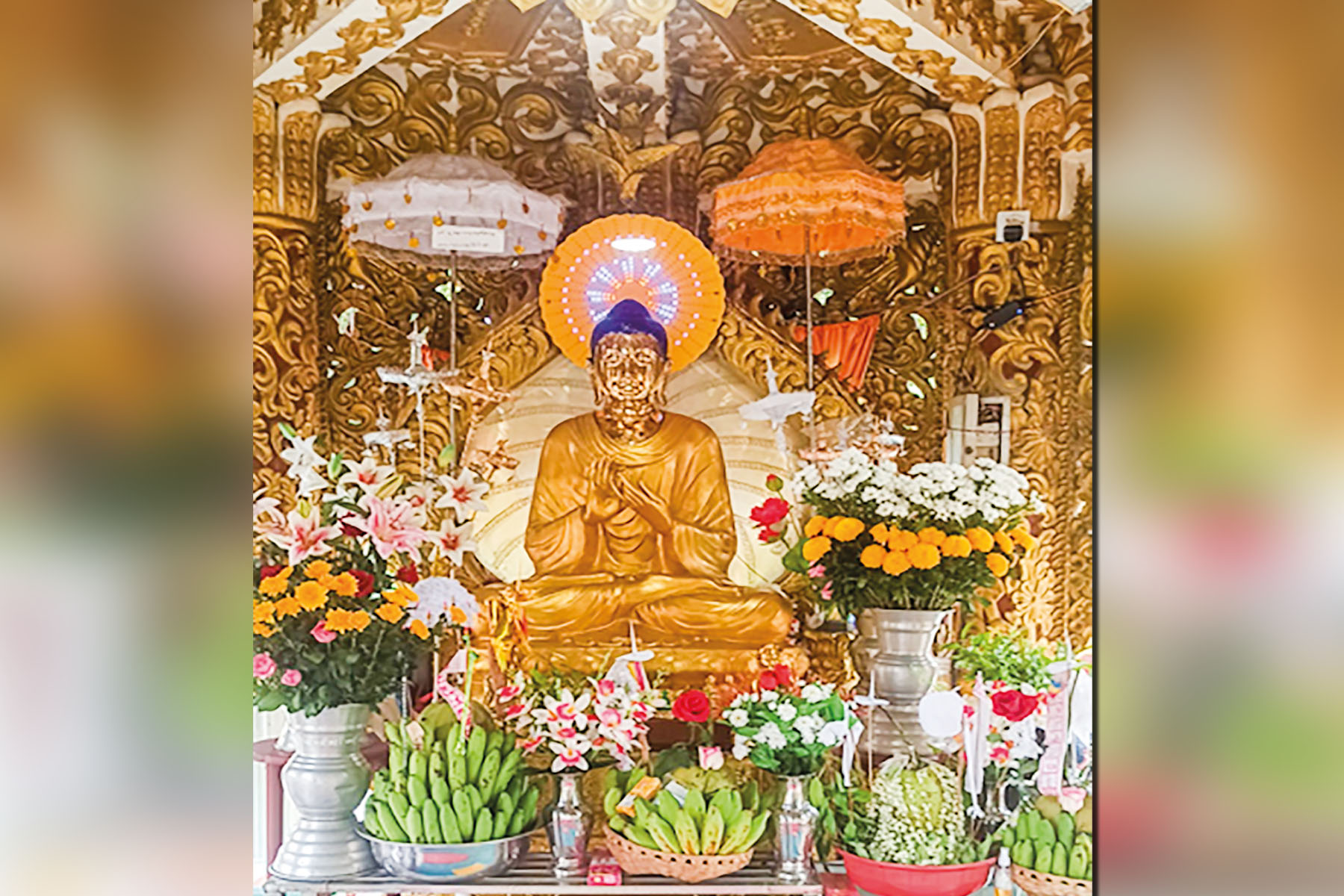
Then we went downstairs to look at the situation of the Buddha Pujaniya festival. Passing a building in which the historic Yakha Mancha Manaungmyin Buddha Image was housed, we walked to the building where the Wutkywaetawpyay Buddha Image was housed. There is the Wutkywaetawpyay Pagoda on the roof of this building. Through the accessible staircase, we walked upstairs. The seated Wutkywaetawpyay Buddha Image is a brass one in Dhammacakka mudra. It is a wish-fulfilled Buddha image. Suddenly, we heard the announcement about the donations people had made for renovations. Even though it was daytime, there were many pilgrims in the festive area. Some stalls were selling food and snacks to the people.
When we rambled and got to the bank of the Ngamoeyeik Creek, we walked along it. There were mangrove forests in the swampy edge of the creek's water. When I looked towards the water surface, I saw herons skimming the water surface, a sampan with the pilgrims in it moving slowly towards the opposite bank and some flotsam carried by the current. Across the creek, the Malamu Pagoda stood serenely on the opposite bank.
When I curiously inquired about the pagoda's background, one member of the Trustee Board told me that the Buddha images had been donated by the Venerable Bhaddanta Siripala, the presiding monk of the pagoda and the Buddha image, on the Wagaung Full Moon Day of Maha Era 1360 (1 January 1999). This Buddha image is called the ‘Wutkywaetawpyay' after the noble intention of the far-sighted Sayadaw to provide spiritual liberation to devotees and to promote the construction of Buddha images and pagodas.
I saw pilgrims from afar and near who came flocking due to the pagoda’s reputation for fulfilling wishes. My friend explained that the Buddha Pujaniya began at 3:30 pm, that during the festive time, the estate adjoining the wide field was vibrant with visitors, monks and festival-goers, that stalls, merry-go-rounds, and Ferris wheels made the atmosphere alive and agog, and that stage shows and Zat Pwe (theatrical performance) started at 9 pm, particularly drawing large crowds on weekends.
It was in daytime that we visited there. Thus, we could not participate in the night events. Instead, we spent time in the cool shade, performing meritorious deeds and enjoying the peaceful environment along the bank of the creek. I bought some traditional Myanmar snacks and souvenirs from a stall for my family members. I also picked up a few old English novels from a make-shift bookshop.
Finally, we made our way back to the Gandayon bus stop, where my friend and I parted. The afternoon sun was intense, and though I had rested under the trees, the heat made me tired. Still, the serene surroundings, sacred images, and the festive spirit of the pagoda compensated me for my fatigue.