
By Ms Monn
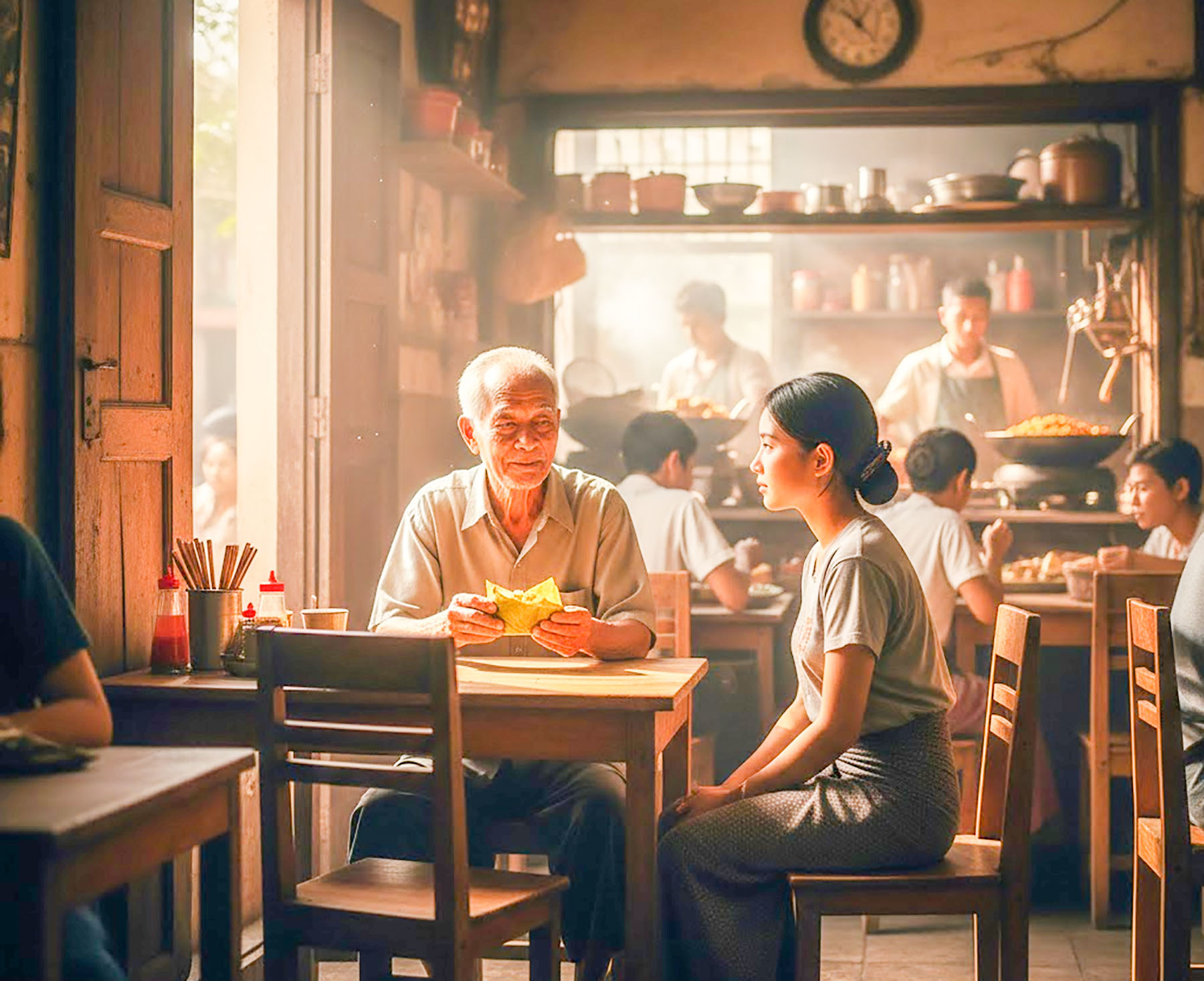
THE midday sun was fierce, and the small restaurant was a bustling oasis of noise and aroma. It was the peak lunch hour, and the place was packed with office workers, shoppers, and market vendors all seeking a quick, affordable meal. The air was thick with the sizzle of frying oil, the rich scent of spices, and the loud chatter of customers entering, leaving, and enjoying their food. I stood just inside the doorway, feeling the heat from both the sun and the crowded room, waiting impatiently for a free spot to sit down.
Finally, I saw a young waiter clearing a small table in the corner. He wiped it down quickly with a damp cloth and called out to me, “Oo Lay, it’s free here now.” I gratefully took the seat, feeling a wave of relief. The simple wooden chair and table felt like a haven.
The waiter, a boy with a friendly smile, approached me again. “What will you have for lunch, Oo Lay?”
I scanned the simple menu written on a board behind the counter. “Please give me fried fish and a salad,” I said.
The service was surprisingly fast. The owner of the shop, a kind-faced woman with a tired but warm expression, brought my order herself. To my surprise, the plate held not only the fried fish I had ordered but also a small helping of a potato curry and some fresh vegetables. It was a simple, generous act that made me feel welcome. I was halfway through my meal, enjoying the flavours, when I heard a new voice at the counter. It was an aged man, his voice thin but clear. “Give me a pack of rice, please,” he said.
The owner responded respectfully, “Of course, Saya. Will you need some curry with that?”
The old man hesitated. “How much does a dish of curry cost?”
“Which curry would you like, Saya?” she asked patiently.
“Egg curry,” he replied after a moment’s thought.
“For one egg, it is 1000 kyat. But if you take a dish with two eggs, it is only 1800 kyat,” the owner explained, trying to offer him a better deal.
“Just one egg, thank you,” the man said quietly.
The owner’s face fell slightly. “Oh, Saya, I am sorry, but we have sold out of eggs. But please, wait for a short while. I have sent my boy to bring more already. They will be here soon.”
The old man nodded and turned to find a place to wait. He chose the small, dwarf chair directly in front of my table. Now that he was closer, I could see him more clearly. He was rather thin, and his clothes, though clean, were faded and a little worn. His posture, however, was straight. He took out a single cigar from his pocket and glanced at me.
“May I smoke?” he asked politely.
I nodded in permission. He lit the cigar and took a slow, deep breath, holding the simple pack of plain rice in his other hand. As I watched him, a wave of sympathy washed over me. I thought he must be very poor, unable to afford even a proper curry to go with his rice. I imagined how difficult his life must be. A thought formed in my mind: perhaps I could quietly offer to pay for a better meal for him. Maybe I could buy him a dish of curry with two eggs. But then, I hesitated. I contemplated the man's situation. Some people have great pride, and such an offer might embarrass or insult them. Furthermore, the shop owner had addressed him as “Saya”, a respectful title for a teacher. I did not know what kind of teacher he was, or what his story might be. I decided to keep my idea to myself for the moment.
Soon, the owner called out, “Saya, the egg curry is ready.”
The old man stood up, walked to the counter, and took the small packet of curry. He then took out a worn K5,000 note from his pocket and offered it to the owner. The shop was still very busy, with several customers waving money to pay their bills. In the confusion, the owner quickly took his note, opened her cash drawer, and handed him his change without really looking at the note he had given her.
I happened to be watching this exchange, though I didn’t know why it caught my attention. But what happened next was unexpected. The old man did not leave. He stood perfectly still, looking at the money in his hand. His brow was furrowed.
The owner, seeing him still there, asked, “Is there something else you would like to buy, Saya?”
“The change is wrong,” he stated clearly.
“Wrong? How much does a pack of rice and one-egg curry cost?” he asked, thinking he had misunderstood the price.
“1,500 kyat. Which is wrong? You have given me back 8,500 kyat,” he said, holding out the notes.
“No, Saya,” the owner replied, shaking her head. “You gave me a 10,000-kyat note. I took 1,500 for the meal, so I gave you 8,500 back. It is correct.”
The old man’s expression became firm. “No, young lady. I gave you just a K5,000 note. You must give me back only K3,500. Here, take back this extra 5,000.” He placed the excess money firmly on the counter. Without waiting for another argument, he turned and walked out of the shop, his pack of rice and curry in hand, his pride intact.
I sat there, stunned. My earlier thoughts and assumptions about him felt foolish and shallow. I had judged him based on his appearance and imagined a story of poverty. But his actions spoke of honesty and integrity that had nothing to do with money. I felt a deep sense of shame. I thought to myself, “If I were in his place, would I have been so honest?” It was a humbling moment.
After finishing my lunch, I walked to the counter to pay. “That will be exactly 4,000 kyat, Oo Lay,” the owner said.
I handed her four K1,000 notes and, remembering the scene, said with a slight smile, “Be careful! You might make a mistake again.”
She laughed softly. “No, never with you, Oo Lay.”
“Then, what about earlier with the old Saya?” I asked, my curiosity getting the better of me.
The owner’s smile faded into a look of respect and a little sadness. “Oo Lay, I did that deliberately. I gave him the wrong change on purpose.”
“What? Deliberately?” I exclaimed, surprised.
“Yes,” she confirmed, her voice soft. “I wanted to help my Sayagyi. I gave him extra money, pretending it was a mistake. But he never accepts anything – not direct aid, not cash, not even a free meal.”
“So, he really is a teacher?” I asked.
“Yes, Oo Lay. He was our headmaster when my brother and I were young. He was a great teacher,” she said, her eyes looking into the past. “He has fallen on hard times since he retired.”
“Oh,” I said, understanding dawning on me. “But you made a big mistake in testing him like that.”
“He has nowhere to live now, Oo Lay. He lives in a small room at the monastery,” she continued, her voice full of emotion. “But his pride is strong. I thought if it seemed like an accident, he might keep the money. But I was wrong.”
I looked at her, seeing the genuine care in her eyes. “Please, don’t test teachers like that in the future,” I said gently. “They all carry a certain pride within them.”
The owner nodded thoughtfully. “I don’t think this is true for every teacher, Oo Lay. But our headmaster… he has a special kind of pride. It is who he is.”
“Yes, yes…” I replied, gazing at her. I left the shop, but the image of the old teacher and the lesson he had taught me about dignity remained vividly in my mind long after I had walked away.