By Dr Kyaw (Meteorology School)
Difficult to Define?
A monsoon is not merely a period of heavy rain. It is a large-scale weather system driven by a seasonally reversed circulation, a massive shift in wind patterns caused by temperature differences between land and ocean. This system is a magnificent natural mechanism for redistributing energy across the globe.
Consequently, pinpointing the monsoon's onset and withdrawal requires more than just measuring rainfall. It demands an understanding of the complex interplay between wind direction, atmospheric humidity, air pressure, sea surface temperature, and kinetic energy. Due to this complexity, meteorologists have developed increasingly sophisticated indices to define these transitions with ever greater precision.
The Evolution of Indices: From Traditional to Modern Science
The history of monsoon indices reflects our growing understanding of climate. Early agrarian communities relied on natural signs — like trees shedding leaves, birds nesting, or wind shifts to predict the monsoon. With the establishment of meteorological departments, indices based on precise rainfall measurements, such as India's Kerala-based index, were introduced.
Following the 1960s, the advent of computer models and satellite data allowed scientists to incorporate global variables like wind flow, moisture transport, and atmospheric energy. Modern indices, such as the Webster & Yang Index, became more complex but also more accurate.
Accurately determining the onset and withdrawal of the monsoon is crucial for regional economic planning, agriculture, and water management. However, declaring a specific "monsoon onset" or "withdrawal" day is inherently complex, as it involves analyzing a multi-layered physical process. Therefore, meteorologists increasingly rely on indices that encapsulate these various physical perspectives, a culmination of decades of scientific debate and refinement.
This article will summarize the development, methodology, strengths, and weaknesses of key indices, tracing their evolution from early rainfall-based measures to modern indices incorporating complex physics.
Definition of Key Monsoon Indices
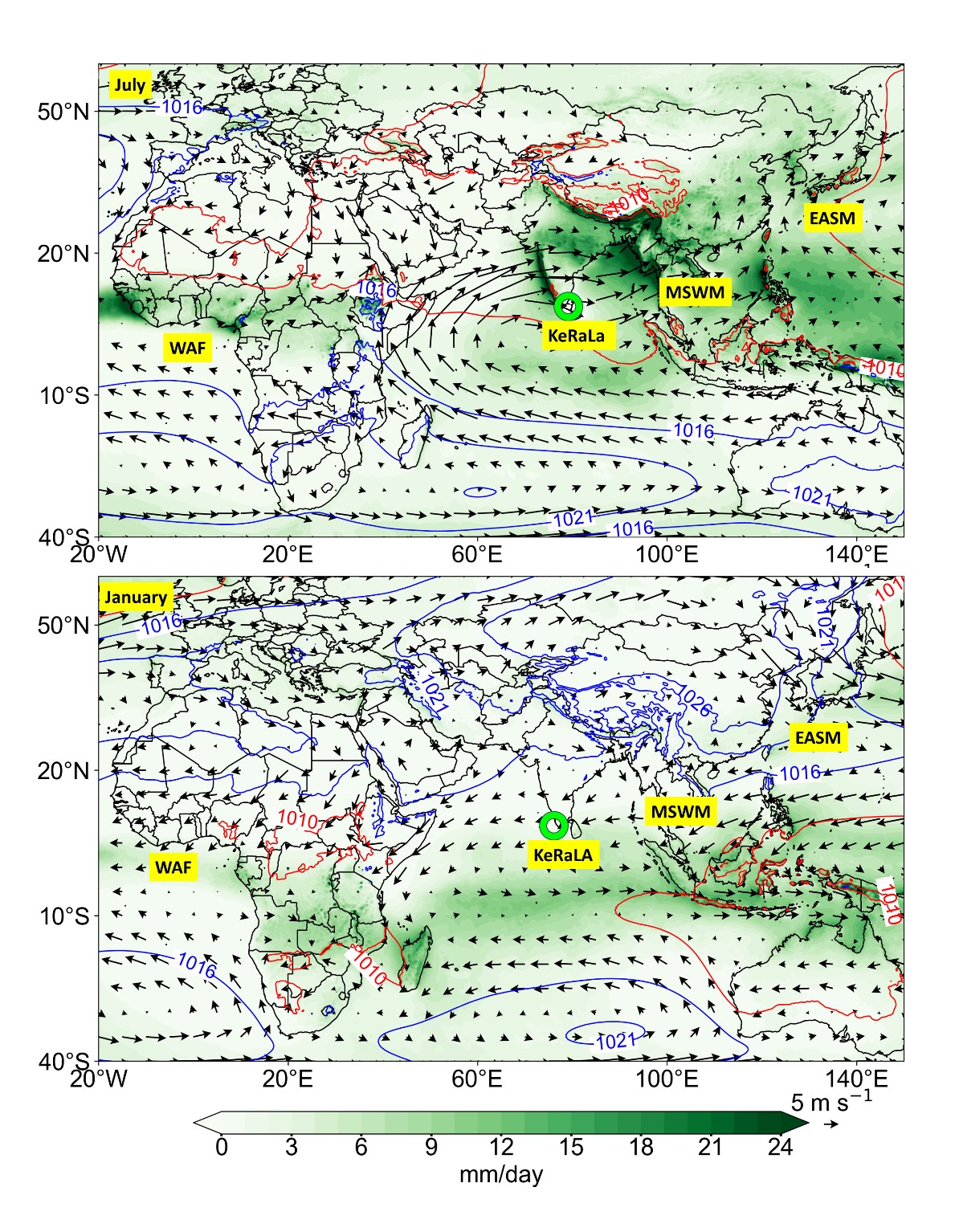
(1) The Kerala-Based Index
• Historical Development: Since the late 1960s, the India Meteorological Department (IMD) has used the "Monsoon Onset over Kerala" (MOK) definition. This index represents an early approach that formalized rainfall observations with mathematical criteria.
• Methodology: The onset is declared when predefined stations in Kerala report rainfall exceeding a specific threshold (e.g., 2.5 millimetres) for two consecutive days, alongside a sustained shift in wind direction to south-westerlies.
• Strengths: It is simple, intuitive, and directly relevant for agricultural planning.
• Weaknesses: It can be triggered by pre-monsoon thunderstorms, leading to false starts. As a regional measure, it poorly represents the dynamics of the broader monsoon system (e.g., it cannot predict the onset over Myanmar).
(2) The Webster & Yang Index (W&Y Index)
• To overcome the limitations of rainfall-only indices, scientists developed indices like the W&Y Index, which uses wind and energy variables to better capture the global nature of the monsoon.
• Historical Development: Introduced in 1992 by meteorologists Peter Webster (UK) and Yang Song (China), this index defines monsoon transitions by analyzing the pronounced shift in wind speed and direction between upper and lower atmospheric levels over a broad Asian region (Webster & Yang, 1992).
• Methodology: The index is calculated as the difference in zonal wind between the lower (850 hPa) and upper (200 hPa) troposphere: W&Y Index = U (850 hPa) - U (200 hPa). A significant change in this value marks the onset or withdrawal.
• Significance: It is a dynamic precursor that measures the core characteristic of the monsoon: the seasonal wind reversal.
(3) The Masumoto Index
• Historical Development: Japanese meteorologist Masumoto proposed this index in 1997 for the Southeast Asian region, utilizing 5-day averaged (pentad) rainfall data. Notably, historical records indicate a Myanmar meteorologist contributed to this project (Masumoto et al., 1997).
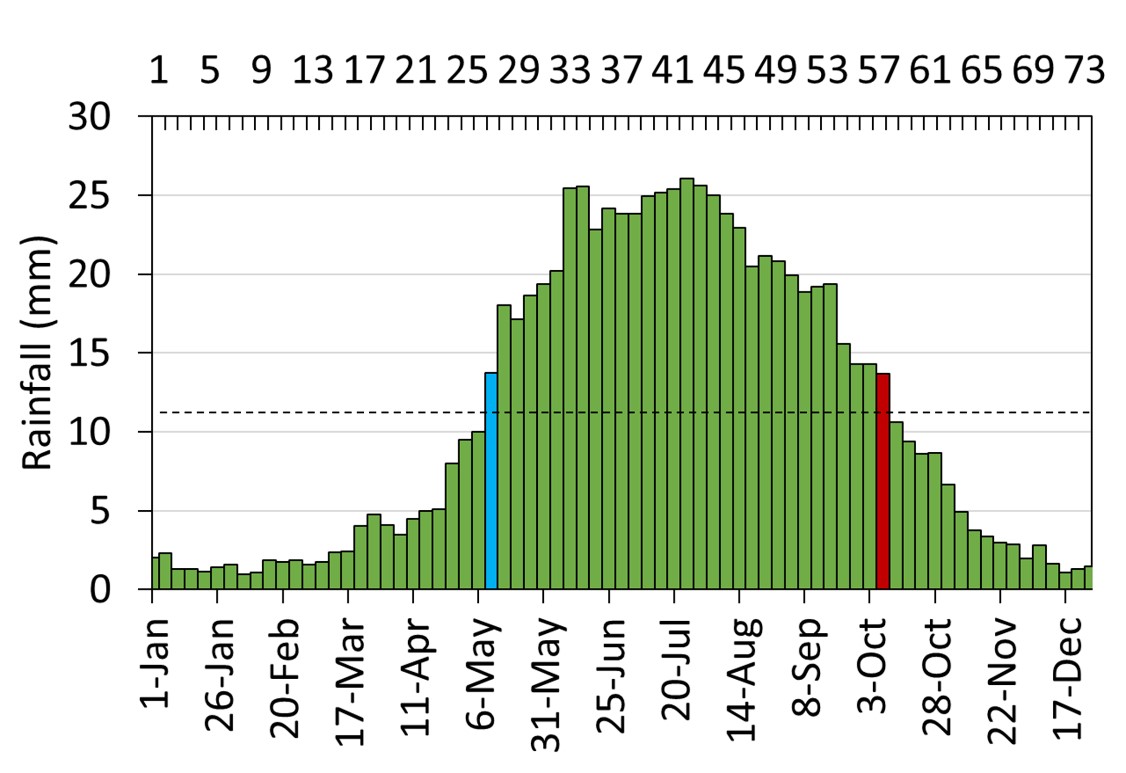
• Methodology: The onset is defined when the area's average pentad rainfall exceeds the annual mean (e.g., 11 mm) and persists for a specified number of consecutive pentads. The middle day of the first qualifying pentad is designated the onset date.
• Significance: While rainfall-based, it introduces the concept of persistence, helping to distinguish the genuine monsoon season from short-lived storm events. Myanmar's Department of Meteorology and Hydrology currently uses this index as a primary tool.
(4) The Myanmar-Indochina Southwest Monsoon (MSWM) Index
Post-2000, with rapid advancements in climate science, researchers began focusing on physically coherent variables, such as moisture transport, tailored to specific regions.
• Historical Development: Around 2020, our research team proposed the MSWM Index for the Indochina Peninsula. It combines data on moisture, rainfall, pressure gradients, and cloudiness, using a Change Point Index (CPI) based on Vertically Integrated Moisture Transport (VIMT) (Kyaw et al., 2020).
• Methodology: It identifies the date of a sudden change (a "change point") in the VIMT over the region. A shift from negative to positive values indicates onset, while the reverse marks withdrawal.
• Significance: Though computationally complex, VIMT is a physically robust variable. The MSWM Index is well-suited for modern climate modelling and computer-based calculations.
(5) The East Asian Summer Monsoon (EASM) Index
The East Asian monsoon, vital for China, Japan, and Korea, is another complex system discussed extensively by experts.
• Historical Development: Among several indices, one proposed by Chinese meteorologist William K.-M. Lau in 2000, which uses Zonal Wind Shear, is widely used for its accuracy (Lau, 2000).
• Methodology: Similar to the W&Y Index, it calculates the wind shear (difference) between U (850 hPa) and U (200 hPa) over a defined East Asian region.
• Significance: It directly correlates with regional weather systems like China's Meiyu, Korea's Changma, and Japan's Baiu frontal systems, allowing for precise tracking of the East Asian monsoon.
(6) The West African Monsoon (WAM) Index
• Historical Development: The West African Monsoon is linked to the movement of the Intertropical Convergence Zone (ITCZ). In 2003, Webster and other experts developed a tailored index for this region: the Hydrological Onset and Withdrawal Index (HOWI) (Webster et al., 2003).
• Methodology: HOWI defines onset when atmospheric moisture content and precipitable water values gradually rise and cross a regionally defined mean threshold. Withdrawal is defined when they fall back below it.
• Significance: HOWI is a useful forecasting tool as it focuses on the broader hydrological cycle and incorporates seasonal total rainfall.
Conclusion
The endeavour to precisely define monsoon transitions began with simple rainfall measurement but has evolved into a sophisticated discipline reflecting the complexities of modern climate science. This journey of innovation also represents significant progress in humanity's understanding of natural environmental systems. While the simplicity of early rainfall-based indices remains useful for some applications and local forecasts, their limitations highlight the need for more scientific indices in the weather prediction process.
Experts recognize that understanding how monsoon cycles may be altered by global climate change is paramount for improving seasonal forecasting. Therefore, future efforts must focus on refining these indices to better encapsulate the monsoon's inherent nature, enabling us to predict how its schedule may shift in our changing world.