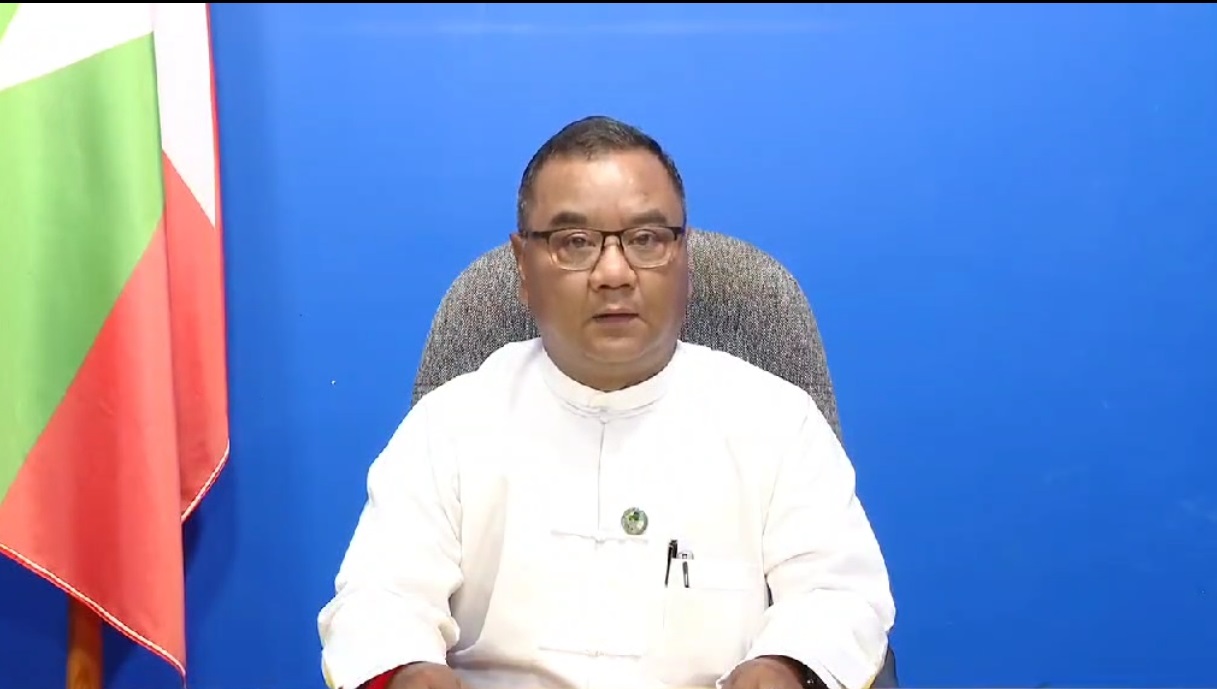
EVERYBODY, Mingalaba! Today, I would like to inform our fellow citizens about the upcoming multiparty democratic general election in our country. All the people know that the first phase of the election will be held on 28 December. As of today, there are only 48 days to go until the first phase. The second phase will take place on 11 January 2026, and the third phase will be held two weeks after the second phase. Regarding the election, we have observed that some individuals who oppose it are spreading misinformation and encouraging misleading beliefs among the public. I am here today to provide clear information to ensure that citizens are well-informed and understand the facts.
In our country, under its own monarchy, there were no elections. However, during the colonial period, as the political awareness of the Myanmar people grew, the British colonial government had to introduce and reform administrative systems. In 1920, the GCBA (General Council of Burmese Associations) emerged and demanded Home Rule. Instead of granting full Home Rule, the British colonial authorities introduced and implemented a dual-administration system called Diarchy. Under the Diarchy system, elections for the Legislative Council were held on 11 November 1922. Historical records show that this was the first election in the history of Myanmar.
Looking back at the elections held in Myanmar, from 1922 to 1947 there were six elections, during the parliamentary period (1948-1962) there were three elections, under the era of the Myanmar Socialist Programme Party (1962-1988) there were four elections, during the State Law and Order Restoration Council/State Peace and Development Council period (1988- 2010) there was one election, and in the democratic era (2010 to the present) there have been six elections, of which three were general elections and three were by-elections. These records show that the people of our country are not unfamiliar with the voting system and have had close experience with it. The government has held elections, and throughout different periods, citizens have exercised their rights by actively participating in voting and making their choices.
In our country, the multiparty democratic system that the people desire has been implemented according to the 2008 Constitution. The first multiparty democratic election was held on 7 November 2010, and the first Hluttaw session convened on 31 January 2011. The second general election under the multiparty democratic system took place on 8 November 2015, with the second Hluttaw session convening on 1 February 2016. The third general election was held on 8 November 2020, during which numerous electoral irregularities occurred. According to the official statement of the Election Commission at that time, there were about 38 million eligible voters, and the number of irregular votes identified was approximately 10.4 million. This is not a mere thousand, ten thousand, or even a million – it exceeds ten million, which accounts for roughly one-fourth of all eligible voters. For these irregularities, political parties and Tatmadaw initially called on the Union Election Commission to resolve the issues according to legal procedures. When this was rejected, they formally requested a special session of the Pyidaungsu Hluttaw as a second step, which was also denied. Even when a third request was made to the government, Pyidaungsu Hluttaw, and the Union Election Commission to find a solution, it was again refused. After all these steps, even when there were two separate requests to convene a meeting of the National Defence and Security Council, no resolution or action was taken. Because of this lack of resolution, the third Hluttaw was convened, and an attempt was made to form a government through force, which led Tatmadaw on 1 February 2021, to assume the responsibilities of the state in accordance with the provisions of the state of emergency in the 2008 Constitution. The reason why all this is being recounted is to clarify history: who lawfully and properly requested legal remedies, and who ignored and violated the law. During this period, I personally, as part of Tatmadaw’s information team, repeatedly held press briefings and provided evidence-backed explanations in front of the international media. All the claims were supported by solid evidence. It was the NLD government and they appointed the Union Election Commission that, instead of resolving the electoral fraud through legal channels, attempted to seize state power unlawfully. They deliberately sabotaged the nationwide, lawfully conducted multiparty democratic system that the public desired. What we are doing now is systematically rebuilding that multiparty democratic system, which the people wanted and which had been deliberately destroyed.
Under the democratic system we practise, the people themselves elect the representatives who will serve in the Hluttaw. For the upcoming multiparty general election, I strongly encourage every eligible citizen to vote. Why is this important? It is because an election is the fastest and most effective mechanism to hear the voice of the people and fulfil the public’s wishes for their well-being. Let me repeat: an election is the fastest and most effective mechanism to hear the voice of the people and address their needs and aspirations. In this election, the people have the right to personally identify and choose candidates who share their views, can closely fulfil their desired goals, and will faithfully represent and work for the interests of the state and the welfare of the public. The representatives you elect can be monitored and held accountable to ensure they fully take responsibility for you and your community. When voters actively participate in elections, the elected representative becomes more responsible. From your personal needs and aspirations to the development and well-being of your neighbourhood, town, village, or region, the representative you choose acts as a direct channel to convey your requests and wishes to the government. I want to emphasize that all citizens should not miss or neglect this opportunity. At this point, I also want to speak about the international recognition and credibility of elections.
In the elections held worldwide in 2024, we can also observe instances where the international community interfered in existing governments, often applying strict and coercive measures. According to the annual election reports on the websites of international democracy and election support organizations, out of 74 elections conducted globally, only 22 were carried out peacefully. In the remaining elections, there were strikes, disputes over results, protests, and even some instances of violence. Criticism and intervention from the international community were also evident. The ability to conduct an election properly depends largely on the political maturity of the respective countries. Even countries that are considered strong democracies globally often face criticism, challenges, and scrutiny regarding the results of their elections.
Our country, by both historical and political context, is a sovereign and independent nation. The authority of our country stems from the people of Myanmar and exists throughout the entire Republic of the Union of Myanmar. Moreover, our country’s foreign policy is conducted independently, actively, and non-aligned. Myanmar has never, and will never, interfere in the internal affairs of other countries. Similarly, our country’s electoral processes, carried out according to our domestic affairs, national context, and history, are matters that concern only our internal affairs and our citizens. I want to make it absolutely clear that no foreign influence or interference can disrupt or alter the course of Myanmar’s elections. We are the people of Myanmar, and it is only the people of Myanmar who have the right to shape the future of Myanmar. Decisions concerning Myanmar must be made by us, the citizens who cast our votes in the elections. That is sufficient.
In Myanmar, a free and fair general election will be conducted under the Constitution, led by the Union Election Commission. In the upcoming election, a total of over 5,000 candidates will compete, representing 57 political parties and 95 independent candidates. To ensure broad representation of ethnic groups and all social strata in the Hluttaw, the election will use the FPTP system for the Pyithu Hluttaw and a mixed-member proportional system (MMP) for the Amyotha Hluttaw and the State/Region Hluttaws. Although there are varied international reactions to Myanmar’s elections, support from partner countries remains strong and solid. The country’s election processes are widely recognized and acknowledged. Because Myanmar’s elections are conducted transparently and securely, partner countries, international organizations, and other nations are invited to observe and study the election process. Domestic and international media are also invited. Modern technology, including MEVM machines, is being used to prevent election fraud. As a result, the parliament formed from this election will be able to demonstrate to the world that it is a legitimate and credible legislature.
A genuine, disciplined multiparty democratic system will only become strong – and a union based on democracy and federal principles can only be built – if the government, the people, Tatmadaw, and all relevant organizations work together in unity towards that common political goal. Therefore, I would like to urge all citizens across the nation to actively participate and cast their votes in the upcoming multiparty democratic general election to be held in December this year and in January next year, so that it can be successfully and smoothly completed. The 2025 multiparty democratic general election must be a definite success. Thank you all.