
A ceremony to commemorate International Anti-Corruption Day was held this morning at the Myanmar International Convention Centre I in Nay Pyi Taw, where U Aung Lin Dwe, Executive Chief of the Office of the National Defence and Security Council, delivered a speech.
The ceremony was attended by State Security and Peace Commission member Union Minister Lt-Gen Tun Tun Naung, Union Chief Justice U Tha Htay, Union Ministers, the Auditor General of the Union, the Chairman of the Union Civil Service Board (UCSB), the Chairman of the Anti-Corruption Commission, the Chairman of the Myanmar National Human Rights Commission, deputy ministers and departmental officials, officials from the Anti-Corruption Commission, officials from the Competition Organizing Sub-committee, winners of the anti-corruption video, poster, and painting competitions, teachers, students, and guests, while the Chief Ministers of the regions and states joined via video conference.
A video message from Senior General Min Aung Hlaing, Acting President of the Republic of the Union of Myanmar and State Security and Peace Commission Chairman, for the International Anti-Corruption Day commemoration ceremony was first shown.
(The video message delivered by Senior General Min Aung Hlaing, Acting President and State Security and Peace Commission Chairman, has been published separately.)
National Defence and Security Council Office Executive Chief U Aung Lin Dwe then delivered a speech, stating that the government is striving to implement reform and development through people-centred approaches to achieve peace, stability, and the rule of law throughout the Union, the unity of all ethnic groups, national prosperity, and food security. In these efforts, it is widely recognized that corruption, along with other disruptions, acts of sabotage, and various challenges, remains a major obstacle.
Corruption occurs in various forms across the fields of politics, economy, and administration. It includes not only the misuse of state funds, money, and assets, but also the abuse of authority and influence.
Those involved in anti-corruption work understand that improving morale is essential for a corruption-free country. Therefore, it is necessary to set future expectations, formulate action plans as part of the strategic framework, and strive to align the public’s expectations with anti-corruption goals as closely as possible.
U Aung Lin Dwe also highlighted the need to teach people from a young age that corruption is a moral weakness and a form of moral corruption, to help them fully understand that it is shameful, and emphasized that more extensive education must be carried out from school age to ensure that young people understand the nature of corruption and learn to prevent and avoid it.
He stated that by training young students to develop good morals and habits of adhering to laws, rules, and regulations, systematically educating them not only in academic skills but also in morals, discipline, and civic knowledge, and cultivating a sense of love for the country and patriotism, to produce well-disciplined and capable human resources, and that the Anti-Corruption Commission has been actively organizing integrity education programmes and youth discussions in basic education schools, universities, and colleges, while encouraging further improvements in these initiatives.
The commission has established Corruption Prevention Units (CPUs) in Union Ministries, organizations, and regional and state governments to conduct integrity education programmes, reduce petty corruption in government departments, and improve departmental services, and is also implementing a Public Feedback Programme (PFP) to gather feedback on services provided to the public.
Such well-intentioned actions will help build a future of integrity, fairness, and justice, enabling all individuals to access the opportunities they deserve and to live healthy lives, both physically and mentally.
Based on Goal 16 of the 17 goals in the United Nations 2030 Agenda for Sustainable Development, Myanmar’s Sustainable and Balanced Development Plan (MSDP) Strategy 1-4 emphasizes “enhancing good governance, accountability, and transparency.” Acting in accordance with this strategy will strengthen the country’s governance and facilitate the successful implementation of sustainable development on a corruption-free foundation.
He then emphasized the necessity of working towards creating an honest and trustworthy society that does not tolerate corruption by encouraging everyone from all sectors to participate in anti-corruption processes starting with individuals, while the commission seeks to further promote the fight against corruption as a national responsibility in line with the purpose of the Anti-Corruption Law – to protect state property, society, and the rights and interests of citizens from corruption, promote greater transparency in governance and the rule of law, and foster domestic and foreign investment and economic development – and he urged not only civil servants and public officials, who play a key role in the country’s administrative apparatus, but also various sectors and organizations to cooperate and participate in the anti-corruption process to ensure its success.
Next, U Lwin Oo, Chairman of the Anti-Corruption Commission, presented the International Anti-Corruption Day commemorative medal to Executive Chief U Aung Lin Dwe.
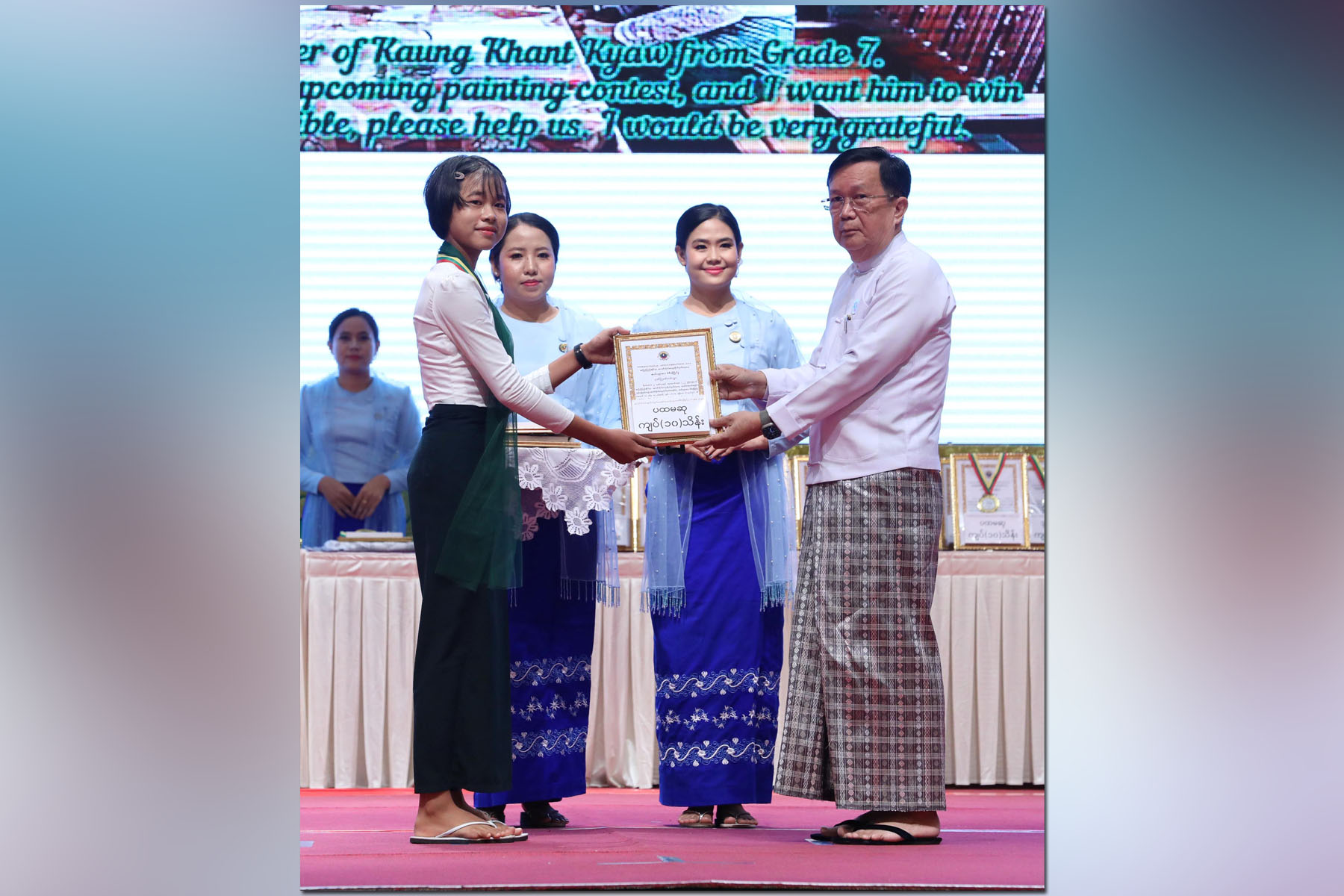
Executive Chief U Aung Lin Dwe then presented medals, certificates of honour, and cash prizes to the first, second, and third-place winners in each age group of the anti-corruption awareness video competition.
Chief Justice of the Union U Tha Htay also presented medals, certificates of honour, and cash prizes to the first, second, and third-place winners in the anti-corruption awareness poster competition for each age group, while the Commission Chairman presented medals, certificates of honour, and cash prizes to the first, second, and third-place winners in the anti-corruption awareness painting competition for each age group.
Afterwards, the first-prize videos in the anti-corruption video competition for each age group were shown, and the Commission Chairman explained the Commission’s anti-corruption activities.
The Executive Chief then watched a video clip of the year-long activities commemorating International Anti-Corruption Day with the attendees, took a group photo, and reviewed documentary photos of anti-corruption activities, as well as books on integrity, investigation, and the fight against corruption.
This year’s 22nd International Anti-Corruption Day is being celebrated under the theme “Uniting with Youth against Corruption: Shaping Tomorrow’s Integrity”. — MNA/TH