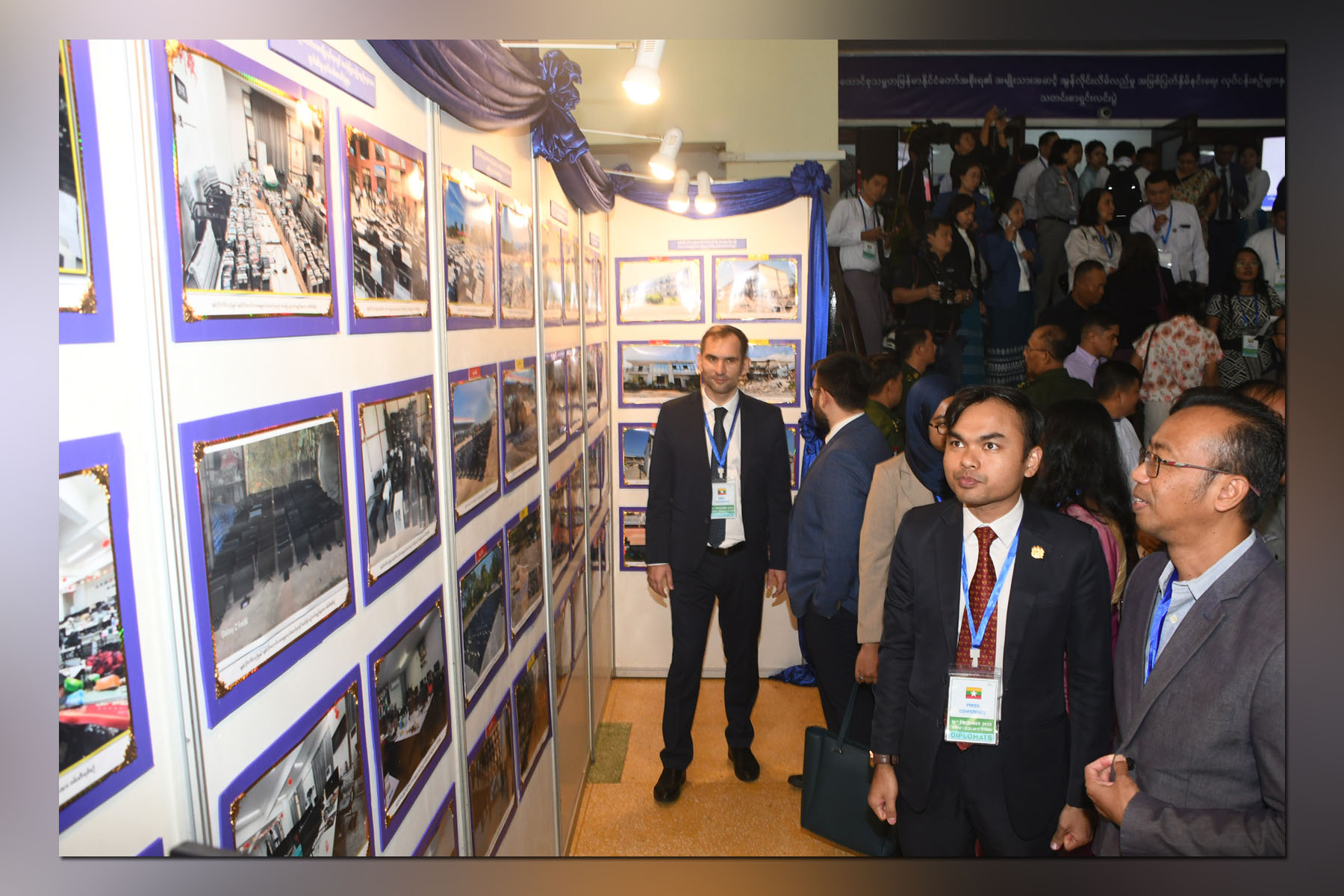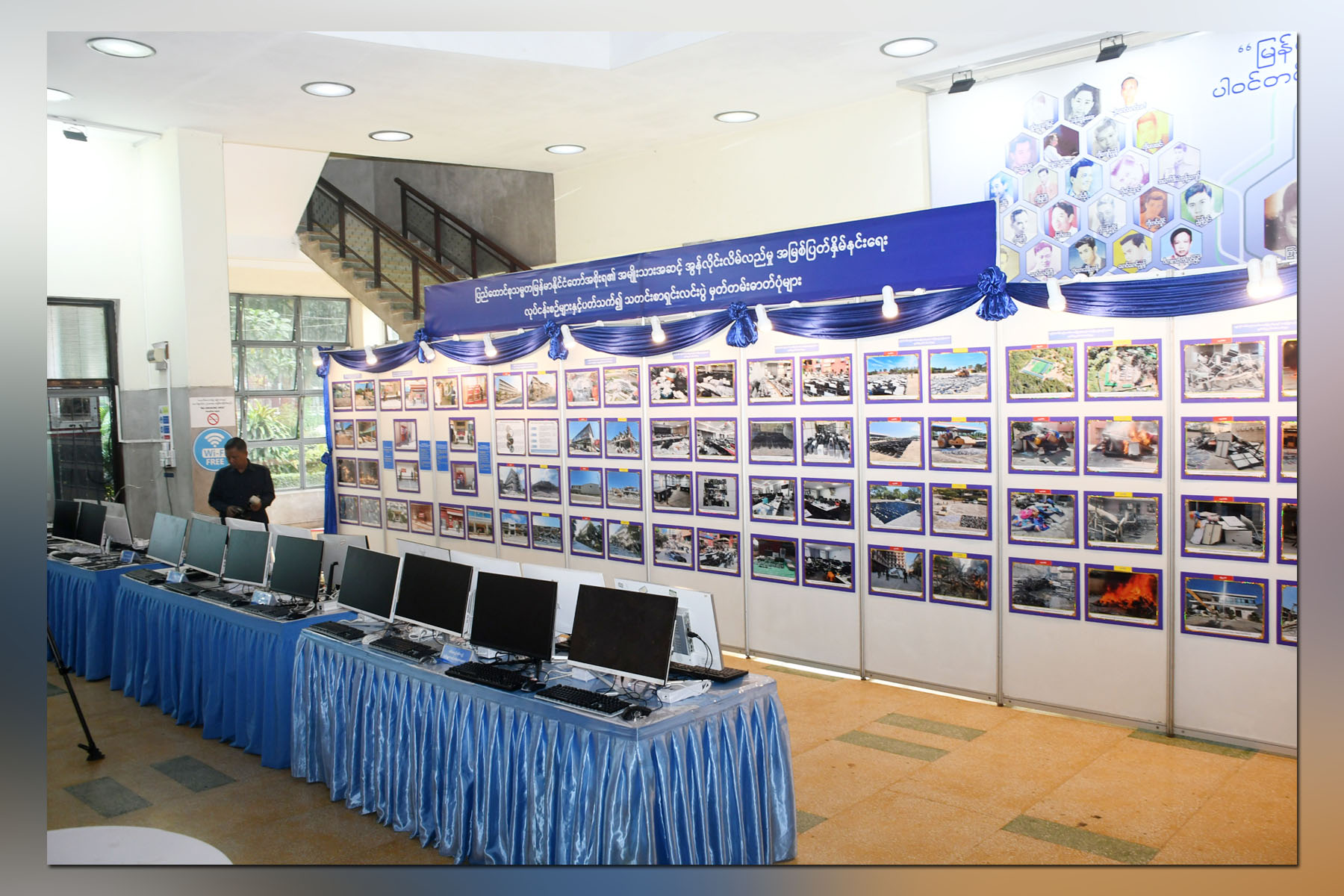
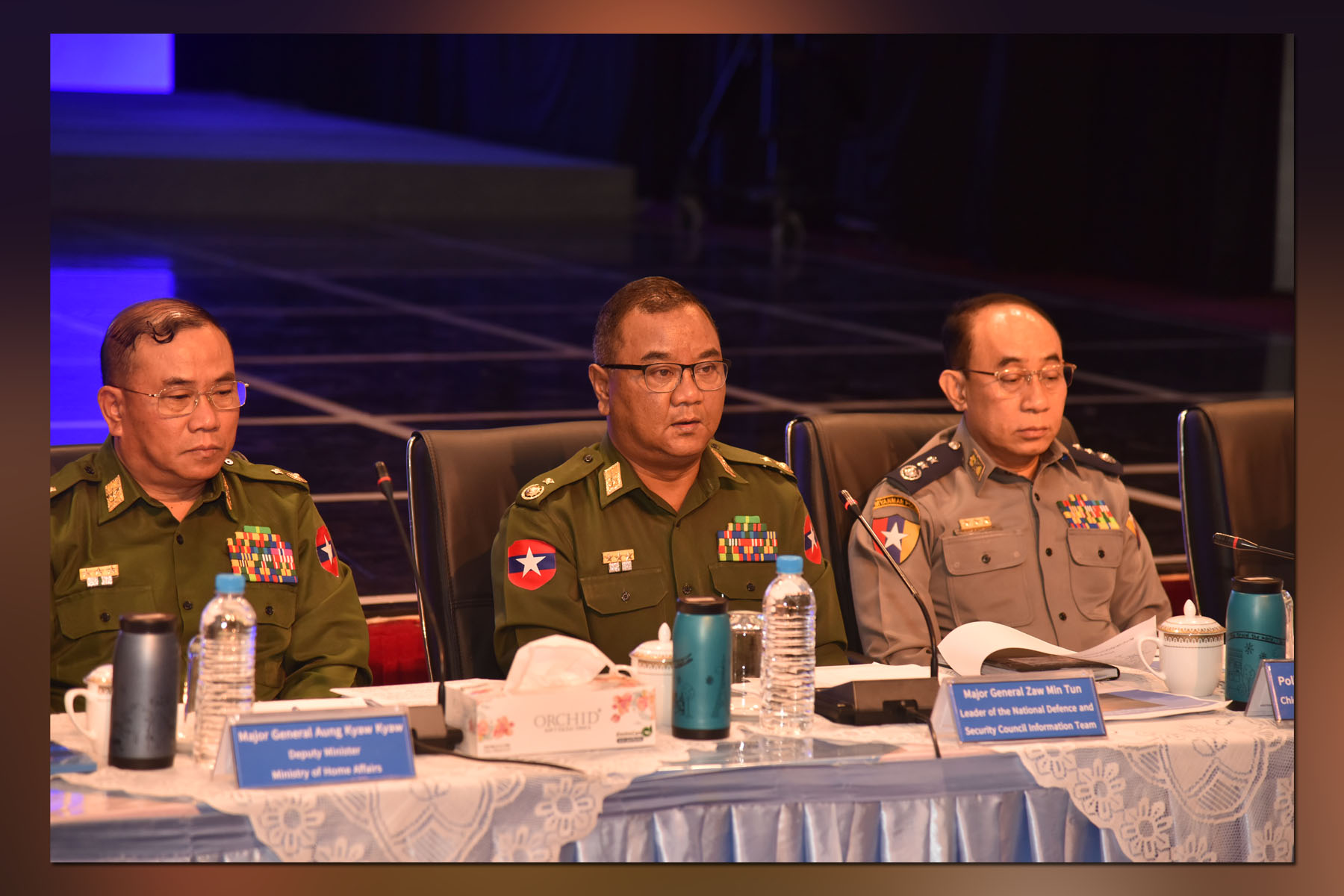
A press conference on national-level telecom fraud prevention process of the government of the Republic of the Union of Myanmar was held at the Myanma Radio and Television on Pyay Road in Kamayut Township of Yangon Region yesterday morning.
Leader of the Information Team of the National Defence and Security Council Deputy Minister for Information Maj- Gen Zaw Min Tun and officials replied to queries raised by media.
Before the clarification, Maj- Gen Zaw Min Tun introduced officials of the press conference: Deputy Minister for Home Affairs Maj-Gen Aung Kyaw Kyaw, Deputy Chief of Military Affairs Security Maj-Gen Khaing Lin, Deputy Commander of South- East Command Brig-Gen Nay Myo, Kayin State Minister for Border Affairs and Security Col Min Thu Kyaw, MPF Chief Police Lt-Gen Win Zaw Moe, Director-General Daw Myo Pa Pa Tun of Political Department of the Ministry of Foreign Affairs, Deputy Leader of the Information Team of NDSC U Thet Swe, Head of the Transnational Crime Division of the MPF Police Brig- Gen Kyaw Zeya and Deputy Permanent Secretary U Myint Kyaw of the Ministry of Information to the attendees.
At today’s press conference, he said that he will explain the efforts of the Government of the Republic of the Union of Myanmar will provide clarifications the national-level operations to suppress telecom fraud to international diplomats and domestic and foreign media. In the clarification, he added the clarifications in sections on combatting the telecom fraud and online gambling activities in Lauukkai and Muse regions of Shan State (North), and Shwe Kokko, KK Park, and Chongkhaed areas in Myawady Township of Kayin State. First, it will be emphasized that telecom fraud and online gambling activities did not originate in Myanmar, a point that has been repeatedly clarified through the media. It will also be highlighted that the main operators of these activities are not Myanmar nationals but foreign nationals.
It is noted that these groups have been conducting such illegal activities while being based in border areas of Myanmar controlled by insurgents. They have taken advantage of the security situation, where the government’s administrative reach is limited, and have operated under the protection of these armed insurgents. The Government of Myanmar clarifies that it has neither permitted nor tolerated these telecom fraud and online gambling activities and continues to actively collaborate with the international community to suppress them.
Telecom fraud and online gambling activities were traced and identified in Myanmar after 2019. Due to the COVID-19 outbreak in 2019, travel between locations was restricted, and these difficult circumstances were exploited to expand online fraud operations within Myanmar. Following the irregularities in the 2020 general election, after Tatmadaw assumed State responsibilities, political instability emerged. Some EAO groups took advantage of the situation by providing arms and military training to violent rioters in order to undermine local security and the rule of law.
Exploiting the resulting deterioration in security conditions, the telecom fraud and online gambling locations further increased. During 2022, investigations revealed that in the Laukkai area of Shan State (North), illegal activities, including telecom fraud and online gambling activities, were being carried out. The individuals primarily responsible for these operations were those who had committed crimes internationally and were on the run, and they led and operated these activities. Therefore, telecom fraud and online gambling activities in these areas were jointly suppressed through a bilateral task force formed with China. Foreign nationals who had illegally entered Myanmar and were involved in online fraud were transferred to their respective countries in accordance with the law. Similarly, in the Muse area of Shan State (North), telecom fraud and online gambling activities were suppressed through joint cooperation between China and Myanmar. Between Myanmar and China, information exchange was carried out between the Myanmar Police Force under the Ministry of Home Affairs and China’s Ministry of Public Security in order to uphold the rule of law and combat telecom fraud and online gambling activities, enabling the identification and arrest of offenders.
As a result of the arrests and crackdowns in Shan State (North), individuals involved in telecom fraud and online gambling activities moved toward Shan State (South). Consequently, in January 2024, around the area of Namsang in January 2024, and in Tachilek in Shan State (East) in July 2024, a total of 1,333 illegal foreign nationals were arrested. These matters have already been officially announced through formal information releases.
During 2023, telecom fraud and online gambling activities moved into the Myawady area along the Thailand–Myanmar border and resumed criminal activities. As a result, trilateral meetings on combating cross-border crimes were held among Myanmar, Thailand, and China in Bangkok and Mae Sot, Thailand, and advance operations targeting online scams and online gambling were carried out. Myanmar, Thailand, and China are working together in a spirit of mutual understanding through effective trilateral cooperation to crack down on cases in which individuals are coerced into committing telecom fraud and online gambling activities in Myanmar’s border areas. The Government has also actively cooperated with neighbouring countries to identify and arrest those involved in telecom fraud and online gambling activities. It has previously been explained how foreign nationals engaged in online gambling and online fraud activities arrived in these areas. Of those who entered the region, 99.6 per cent crossed into Myanmar via neighbouring countries. Illegal foreign nationals who entered Myanmar through unauthorized routes and were involved in telecom fraud and online gambling activities are being continuously arrested and repatriated to their respective countries.
The origins of telecom fraud and online gambling activities in the Myawady area of Kayin State can be traced back to the Shwe Kokko Project, which began in 2017. The Shwe Kokko Project refers to the Myanmar–Yatai Shwe Kokko Special Economic Zone project jointly implemented by Yatai International Holding Group and Chit Linn Myaing Company. Preparations for the project had begun around 2016, and it is understood that consultations were held at that time with the Chief Minister of Kayin State under the NLD government. Subsequently, in April 2017, approval was reportedly sought from the Myanmar Investment Commission. When the project proposals were submitted, there were no plans included for the construction of casinos. However, in early 2019, public complaints were filed alleging that construction exceeded the approved scope. As a result, the then-responsible NLD government formed an investigation committee in August 2019, and the project was temporarily suspended. It was also noted that the matter was raised through questions and answers during the 17th regular session of the Second Pyidaungsu Hluttaw. Later, individuals associated with gambling activities were found to have disseminated propaganda suggesting that the suspended project was part of China’s Belt and Road Initiative (BRI) in order to resume operations. Consequently, the Chinese Embassy to Myanmar officially clarified that the Shwe Kokko Project was not included in the BRI. This was further explained by Ambassador Mr Chen Hai during a meeting with the Commander-in-Chief of Defence Services currently the Acting President in July 2020. It was also stated that only the Shwe Kokko Project had been partially submitted to the State authorities, while other projects such as Chongkhaed and KK Park had not been submitted at all.
He continued that the Chongkhaed Garden Resort casino project being carried out in Chongkhaed Village, Myawady Township, was initiated in 2017 by Sai Kyaw Hla, a brigadier-general–level figure from the KKO group. It was also found through investigations that in November 2019, a contract was signed with Thailand-based Thai Chan Company, after which telecom fraud and online gambling activities were expanded.
It was further stated that the KK Park project was launched after a memorandum of agreement was signed in February 2020 between Mulaei Alin Company of the KNU and Thailand-based Trans Asia International Holding Group, a subsidiary of Huanya International Holding Group. It was also explained that the agreement bears the signatures, as witnesses on behalf of Mulaei Alin, of Saw Kwe Htoo Win, who is currently serving as Chairman of the KNU, and Saw Roger Khin, the head of the KNU Defence Department. In addition, investigations found that Mulaei Alin Company is owned by Saw Doe Soe Johnny, the eldest son of Saw Johnny, who holds the rank of KNLA Chief of Staff, and that on the ground the operations are being carried out by his close associates, Saw Win Kyaw and Saw Kyaw Thu.
He added that taking advantage of the national security situation following political developments after February 2021, illegal buildings had been increasingly constructed in those areas. As this was identified, instructions were issued as early as February 2023 to the relevant Kayin State government to inspect and closely supervise the situation to prevent construction of illegal buildings and occupation. Accordingly, successive levels of administrative bodies implemented these measures, legal action was taken against holders of farmland use rights certificates (Form-7) in areas where illegal buildings were constructed, and their land-use rights have already been revoked in accordance with legal procedures.
He reveiled that illegal criminal activities cannot be carried out in areas where the State government’s administrative mechanisms are effective and where stability and peace prevail. It was explained that on 27 March 2021, KNU Brigade (5) launched an attack and seized the Theemuhta area-based security outpost in Papun Township, thereby violating the NCA agreements and beginning actions that undermined regional stability. On 5 April 2024, KNU and PDF groups jointly attacked and seized Thingan-Nyinaung, and terrorist groups took control of the Asia Highway between Kawkareik and Thingan-Nyinaung. Across border areas of Kayin State, the KNU and allied terrorist groups engaged in fighting against security and administrative bodies, deliberately destabilizing the region. Such actions were aimed at removing State security and administrative institutions from KNU-controlled areas, after which terrorist groups provided paid protection and unlawfully facilitated the ongoing online fraud, online gambling, and other criminal activities.
He explained that the government has regarded the eradication of online fraud and online gambling operations as a national duty and, in line with its objective to eliminate them at their roots, was able to retake control — at the cost of the lives, blood, and sweat of security personnel — of the Kyondo–Kawkareik section of the Asia Highway, which had been temporarily controlled by insurgents, in July 2025, as well as Kawkareik and the Kawkareik– Thingan-Nyinaung road section in September. Tatmadaw had to conduct difficult counteroffensives to restore stability after the KNU and allied insurgent groups used illegally obtained funds and large amounts of manpower and financial resources to undermine regional stability and the rule of law. It was further stated that on 19 October, control was regained over border areas along the entire stretch, including Laykaekaw, and territorial control and security operations were restored in the Myawady area.
It was stated that foreign nationals who entered Myanmar and engaged in illegal activities, including online fraud and online gambling, continue to be continuously arrested, detained, and repatriated to their respective countries.
From 5 October 2023, to 11 December 2025, a total of 70,135 foreign nationals from 54 countries were repatriated. In order to prevent telecom fraud and online gambling activities from reestablishing themselves in the Myawady area, illegally constructed buildings have been completely demolished and cleared. As of 13 December 2025, a total of 413 buildings in the KK Park area were demolished, and the remaining 222 buildings are planned to be cleared as well. Regarding the efforts to completely eradicate online fraud and gambling operations, it was noted that KNLA and PDF terrorist groups have been interfering by staging attacks in Myawady, Laykaekaw, and surrounding areas. Between 13 October and 8 December 2025, there were 56 such clashes, during which some security personnel sacrificed their lives. Despite this, operations to eliminate illegal criminal activities will continue until the objectives are fully achieved. In these areas, remaining illegal buildings are being destroyed to prevent the resumption of online gambling, including through demolition, controlled explosions, and cutting off water sources to ensure that operations cannot be reestablished.
Regarding the confessions of the foreign nationals who were arrested and detained, it was noted that they entered Myanmar from a neighbouring country, which has already been reported by the authorities. Their statements are now being presented, and many similar statements have also been collected. It is expected that the visiting diplomats attending this press conference will gain a detailed understanding of the statements of those who illegally entered Myanmar. By reviewing these statements, it becomes clear who was involved in the online fraud and online gambling activities.
He mentioned that as the Government of Myanmar has been fully responsible for the custody and care of foreign nationals under humanitarian even though their own governments have not yet come to collect them. This duty is of great importance. The state has provided for all their needs, including daily food, drinking water, bathing water, clothing, and bedding. The daily cost of food and essentials for one person amounts to at least K15,000. From 10 December 2024 to 22 November 2025, a total of over K1.336 billion (K1,336,050,000) was spent on these expenses. The government emphasizes that this action is carried out in the interest of national dignity. So, the relevant countries need to urgently send representatives to collect their citizens who are still remaining.
He disclosed that he will continue to clarify the stance, position, and policies of the Government of Myanmar regarding online scamming and online gambling. The Government of Myanmar considers online scams and gambling as a national security threat, as they undermine public trust in the government, threaten economic security, deteriorate national stability and damage the country’s national dignity. Foreign nationals, some Ethnic Armed Organizations (EAOs), armed groups, and certain unscrupulous businesspeople who have illegally entered and operated these activities within Myanmar have caused significant harm to security and stability in Shan State (North) and parts of Kayin State. As a result, Myanmar’s national dignity has been diminished internationally. Therefore, the people of Myanmar have suffered severely from the consequences of online scams and crimes. The Government of Myanmar and the Myanmar public loathe online scams and gambling even more intensely than foreign actors do. The Myanmar government also officially classifies online scamming as a crime committed against the general public.
The Government of Myanmar will take decisive action against those who commit online fraud and related crimes. There will be no second chance; no one will be given a second opportunity. There will be no political or personal protection; individuals will not be shielded for personal or political reasons. Online fraud and criminal activities often occur in areas with low stability and weak legal enforcement. These crimes are frequently conducted as international organized crime, involving unscrupulous actors from multiple countries. Therefore, the government will actively cooperate both internationally and regionally to combat these crimes.The Government of Myanmar has established Task Forces and cooperative groups to work efficiently and collaboratively, and it will continue to do so vigorously and effectively in the future.
He clarified that telecom fraud involves deception through the use of communication networks. Citizens of Myanmar have also become victims of such fraudulent activities. Between 2023 and November 2025, approximately 800 people in Myanmar experienced online fraud and filed complaints. There are likely to be many more cases with opening files that have not yet been reported or resolved.
Regarding the demolition and destruction of buildings in KK Park and Shwe Kokko areas, which were used for telecom fraud, it is astonishing to note criticisms from some destructive media claiming that evidence was being destroyed. Myanmar government systematically detained, registered, and investigated those present in these areas. All evidence was properly collected, and the findings, inspections, and testimonies were thoroughly examined, verified, and reported. As a result of these actions, in November and December of this year, 34 individuals involved in telecom fraud and associated evidence were captured near Mongnawng of Kehsi Township in Shan State (South). The demolition of buildings used for online fraud in KK Park and Shwe Kokko aims to prevent the recurrence of such crimes in these areas and to ensure that no illegal activities can take place there in the future. Records and investigations obtained will be released as appropriate in future public statements.
He noted that regarding online fraud, Myanmar government has been informing and warning the public through domestic media. Various awareness and precautionary measures are being communicated to prevent people from becoming victims. As some important points, the first one is that do not open links received on your phone from unknown sources, and do not view messages from unknown senders; the second, if you fall victim to online fraud, do not try to handle it alone; report it immediately to the responsible authorities. Public reporting and notifications are extremely valuable, as they allow the authorities to trace and take action against the fraudsters. The third is that citizens are requested to cooperate reliably and faithfully with government authorities to help prevent and combat online fraud effectively.
He continued that Myanmar government respectfully informs you about the policies and methods it will continue to implement regarding online scams and online gambling. For the first one, the government identified online scams and online gambling as serious crimes. The government’s policy is Zero Tolerance: whether the offense is minor or major, there will be no leniency; all perpetrators will be aggressively investigated and punished. The second one is that the method the government will employ is the Aggressive Crackdowns Method, meaning strict and forceful action will be taken against offenders. To carry out these measures, the Central Supervisory Committee on Combatting Telecom Fraud and Online Gambling has been established at the national level on on 10 December 2025.
Moreover, he requested the Myanmar people that dear people of Myanmar, Your Safety is Our Responsibility. Ensuring the safety of the public is our primary duty. Your Trust is Our Priority. Your trust is our obligation and responsibility. In this spirit, we will continue to carry out our duties, and we sincerely thank you all.
Deputy Minister for Home Affairs Maj-Gen Aung Kyaw Kyaw continued, saying that there are difficulties and limitations in the rule of law and administrative processes in areas where armed groups are active and online scams are being carried out in Myanmar, and that it is widely known that those running these businesses are mostly foreigners taking advantage of the current political situation. The government of Myanmar established the “Central Committee for the Supervision of Deportation and Transfer of Detained Foreigners for Illegal Entry into Myanmar” on 8 November 2023 to ensure the effective deportation of foreigners who have entered Myanmar illegally in accordance with procedures, and the central committee is continuing to form a supervisory committee, subcommittees, and secretariat to carry out its duties efficiently.
The deputy minister said that, to eradicate online fraud in border areas, prevent its spread to the interior, and effectively combat online fraud and gambling in line with the policy of the Head of State, the government formed the “Central Supervisory Committee on Combating Telecom Fraud and Online Gambling” on 10 December 2025. The committee will be chaired by the Union Minister for Home Affairs, Lt-Gen Tun Tun Naung, with the deputy minister serving as secretary, and is composed of representatives from relevant ministries and organizations. To carry out its duties effectively, the committee convened a meeting immediately on 11 December. On 12 December, the “Union Territory Committee on Combating Telecom Fraud and Online Gambling” and the “Region or State Committee on Combating Telecom Fraud and Online Gambling” were established under the supervision of the central committee. The Chairman of the Nay Pyi Taw Council serves as the Chairman of the Union Territory Committee, with one Council member serving as secretary. The chief ministers of the relevant region or state governments serve as chairmen, and the ministers of security and border affairs serve as secretaries of the respective region or state committees.
The central committee will carry out tasks such as setting policies to combat telecom fraud and online gambling, forming necessary committees and assigning responsibilities, drafting Standard Operating Procedures (SOPs), coordinating with relevant countries to repatriate foreigners working illegally in these industries, and promoting international cooperation, he said.
He said that action had been taken against those entering Myanmar illegally, including individuals involved in online fraud and online gambling, and that 70,196 foreigners were identified in Shan and Kayin States from 5 October 2023 to 13 December 2025 and repatriated to their respective countries in accordance with procedures.
According to the testimonies of foreigners who were rescued in Kayin State, they entered Thailand by air and travelled from Bangkok to Mae Sot by car or plane, then illegally crossed the Thaungyin River from Mae Sot to join companies in Myawady Township, Kayin State, others arrived at Yangon International Airport in Myanmar with a valid visa and travelled by car to Myawady Township to join companies there. In percentage terms, 99.6 per cent crossed from Mae Sot, while 0.4 per cent travelled through domestic routes. Although the relevant embassies have requested assistance by claiming that their citizens are victims of human trafficking, investigations revealed that some of them are not trafficking victims and are working for their own benefit. For example, although they were rescued from the Myawady region and repatriated to their respective countries, it was found that one Chinese national, one Malaysian national, five Indian nationals, and several others had re-entered the country and were again engaged in illegal activities.
Maj-Gen Aung Kyaw Kyaw said that, due to the ongoing efforts of the Tatmadaw and police, 13,272 foreigners were rescued in the Myawady region between 30 January and 13 December 2025. Of these, 11,617 have been repatriated to their respective countries, while arrangements are being made to transfer the remaining 1,655. He added that Maj-Gen Zaw Min Tun has already ensured that their living and food needs are being met. However, some challenges remain, as the foreigners are being held in large halls, such as indoor sports halls, and come from different countries with varying personalities, making management difficult. He called on the diplomats present to assist in facilitating their return as soon as possible.
It was found that the necessary building materials, appliances, consumer goods, electricity, fuel, internet, and other resources for buildings used in online fraud activities were not sourced within the country but were purchased and supplied through other countries.
The Myanmar-China-Thailand trilateral cooperation is working to combat online fraud and online gambling in the Myawaddy region of Karen State and has held three high-level meetings and two ministerial-level meetings. The Lancang-Mekong six-country Ministerial Meeting on Joint Action Against Online Fraud was held in Kunming, China, on 14 November 2025, with the Myanmar delegation, led by Deputy Minister Maj-Gen Aung Kyaw Kyaw, in attendance. Similarly, the Union Minister personally attended the 6th Coordinated Mekong Ministerial Initiative against Trafficking (COMMIT), hosted by Vietnam on 19 November 2025, where he discussed jointly combating the misuse of technology to commit violent crimes.
These crimes should be viewed as a multifaceted criminal enterprise rather than being confined to Myanmar. While Myanmar is the location of some scam centers, it is not the root cause or the main beneficiary of these crimes, and not all money generated from fraud enters Myanmar’s banking system. According to the United Nations Convention against Transnational Organized Crime (UNTOC), every country has a responsibility to combat all relevant elements of such crimes. To address this problem, all countries must fully play their roles in accordance with international standards. Myanmar has identified and rescued victims of human trafficking from conflict areas and is actively cooperating with relevant embassies and organizations to repatriate them safely to their countries of origin.
Deputy Minister for Home Affairs Maj-Gen Aung Kyaw Kyaw said the international community recognizes the challenges facing Myanmar and supports intelligence sharing, adding that practical assistance should be provided through technical and training support. He stressed that Myanmar cannot solve the problem alone and that only through international cooperation — via UNODC and other partners — can online scam networks be effectively dismantled. He urged all parties to work together rather than place blame.
MPF Chief Police Lt- Gen Win Zaw Moe said that the deputy minister has clarified measures for online scam. He will provide a summary and explanation regarding the Myanmar Police Force’s ongoing actions concerning online scams and related transnational crimes, including matters related to human trafficking, financial crimes, and narcotics offenses.
Myanmar, has designated the fight against human trafficking as a national responsibility. Section 358 of the Constitution states that “ The Union prohibits the enslaving and trafficking in persons.” Myanmar has also acceded as a member to the United Nations Convention on Transnational Organized Crime and its related protocols. Following this, Myanmar enacted the Anti-Human Trafficking Law in 2005. This law was further amended and clearly strengthened on 16 June 2022, to align with modern standards and serve as a more comprehensive law for preventing and combatting human trafficking.
Under this new law, Myanmar has expanded and established several committees to effectively combat human trafficking. These include the Central Committee for the Prevention and Suppression of Human Trafficking, the Committee for the Protection of Human Trafficking Victims, the Committee for International Relations and Cooperation, the Committee for Legal Affairs and Prosecution, the Committee for the Reintegration and Rehabilitation of Human Trafficking Victims, the Committee for Implementing Myanmar’s Five-Year National Plan for Combatting Human Trafficking and other necessary committees. These bodies have been actively working to carry out human trafficking prevention and suppression measures in a comprehensive and effective manner.
Investigations and actions have been effectively carried out to uncover human trafficking cases and impose appropriate penalties. From 1 January to 13 December 2025, a total of 139 human trafficking cases were investigated and prosecuted. Among them, 402 offenders were charged, and 116 received effective sentences. Regarding imprisonment, 14 individuals received life sentences, 25 individuals were sentenced to 20-25 years in prison, 63 individuals were sentenced to 10-15 years in prison, 14 individuals received sentences of less than eight years.
To control illegal departures abroad that could lead to human trafficking, actions have been taken against illegal transporters. From 1 January to 13 December 2025, a total of 59 cases were handled under the Overseas Employment Law, and 128 offenders (53 males and 75 females) were investigated and prosecuted to ensure effective punishment.
The country is cooperating not only domestically but also with international organizations to combat human trafficking.
On 24 April 2009, the memorandum of understanding between Myanmar-Thailand on Combatting Human Trafficking was signed. Similarly, Myanmar has signed and is jointly implementing bilateral cooperation and memoranda of understanding with China, Laos, Vietnam, and India.
Furthermore, the Coordinated Mekong Ministerial Initiative against Trafficking (COMMIT MOU), involving six neighbouring countries — Cambodia, China, Laos, Myanmar, Thailand, and Vietnam — was signed in Yangon on 29 October 2004. According to the memorandum of understanding, Inter-Ministerial Meetings (IMM) are held once every three years, and Senior Officials’ Meetings (SOM) are held once a year. In addition, since 2011, the COMMIT Regional Task Force and the Youth Forum have been jointly organized on a rotating host basis.
Furthermore, it was stated that since 2004, the Bay of Bengal Initiative for Multi-Sectoral Technical and Economic Cooperation (BIMSTEC), which includes South Asian countries such as Bangladesh, Bhutan, India, Myanmar, Nepal, Sri Lanka, and Thailand, has been cooperating in operations to combat cross-border crimes, including human trafficking.
Regarding human trafficking, especially of women and children, Myanmar signed the ASEAN Convention against Trafficking in Persons, Especially Women and Children on 21 November 2015, and the convention was ratified on 6 January 2017. It was stated that as ASEAN member countries, they are cooperating effectively across ASEAN sectors and among sectoral groups to implement the ASEAN Convention, ASEAN declarations, ASEAN work plans, and the comprehensive ASEAN sectoral plans (Bohol Work Plans).
He continued his discussion about information on the prevention and eradication of the dangers of narcotic drugs and psychotropic substances. The drug problem is not confined to a single country, region, or ethnicity, but is a serious issue threatening all of humanity worldwide. The production, consumption, and trafficking of drugs are closely linked to transnational crime, corruption, arms smuggling, and terrorism, and they continue to undermine national peace, the rule of law, and security.
It has been observed that some armed ethnic groups within Myanmar are deliberately undermining peace and stability in the country, taking advantage of the situation to engage in the production and trafficking of drugs, which is an easy source of income. Although the chemical substances and related materials used in drug production cannot be manufactured within Myanmar, they are easily smuggled in through border areas. Most of the drugs produced are then transported and sold via these border regions to neighbouring countries and other nations with high demand. As a result, efforts to prevent and suppress drug-related activities continue to face significant challenges.
Myanmar established the Central Committee for the Drug Abuse Control in 1976. To strengthen and accelerate anti-drug operations, the country expanded its Drug Enforcement Division under the Myanmar Police Force into 11 divisions and 71 sections, equipping them with modern investigative tools and continuing to carry out operations.
Regarding drug seizures and enforcement actions, from 2021 to November 2025, a total of 30,420 drug-related cases were handled, involving 36,885 male defendants and 5,874 female defendants, totalling 42,759 defendants. The seizures included over 7.2 tonnes of opium, over 9.4 tonnes of heroin, over four tonnes of marijuana, more than 1,138 million stimulant tablets, over 107 tonnes of ICE, 22.2 tonnes of ketamine, over 866 kilogrammes of Happy Water, 1,166,002 ATS tablets, and other narcotics, along with over 89.6 tonnes of caffeine and other controlled chemical substances. The total value of all these drugs and chemical substances amounted to more than K5,570.7 billion.
Furthermore, from 2021 to October 2025, among drug-related cases involving arms and ammunition, there were 174 cases with 379 male defendants and 26 female defendants, totalling 405 defendants. Authorities seized 709 various arms, 303 different types of bombs, 61 mines, 137,550 assorted bullets, 1,645 magazines, over 159 kilogrammes of gunpowder, 1,157,634 detonators of various types, and related materials.
It is reported that narcotics and chemical substances with a total value of over K1,068.66 billion in 2021, over K1,188.828 billion in 2022, over K936.723 billion in 2023, over K1,163.648 billion in 2024, and over K971.79 billion in 2025 — amounting to a total of more than K5,329 billion — were successfully destroyed by incineration.
In connection with drug-related activities, the government also carried out seizures for the State Treasury. From 2021 to October 2025, a total of 4,197 cases resulted in the confiscation of over K488 million, 3,612,120 Thai baht, 500 Chinese yuan, US$2,000, 2.5 ticals of gold, 477 motor vehicles, 2,438 motorcycles, 596 phones, seven tricycles, five three-wheeled motorcycles, 19 bicycles, one battery-powered motorcycle, one sidecar motorcycle, 35 motorboats, one trawlergy, two air coolers, and one backpack, with a total estimated value of over K13,044 million.
Myanmar is implementing measures to prevent and control the dangers of narcotic drugs in cooperation with international partners, including ASEAN member countries, countries in the Greater Mekong Subregion, BIMSTEC member countries, and neighbouring nations. In addition, Myanmar is closely collaborating with the United Nations Office on Drugs and Crime (UNODC), the Australian Federal Police (AFP), the United States Drug Enforcement Administration (DEA), China’s National Narcotics Control Commission (NNCC), and Thailand’s Office of the Narcotics Control Board (ONCB).
Furthermore, actions to prevent and suppress financial crimes were explained. The Financial Crime Suppression Police of the Financial Investigation Unit under the MPF operates its functions under the Anti-Money Laundering Law by receiving Suspicious Transaction Reports (STRs) submitted by reporting organizations, examining and analyzing them, and distributing the results of these investigations to the relevant law enforcement authorities and concerned departments or agencies.
In connection with combating money laundering and the financing of terrorism, Myanmar has established the Central Committee for Combating Money Laundering, formulating and implementing national-level strategies. To ensure that members can efficiently and promptly carry out their respective departmental duties when financial frauds and crimes arise, an “Action Task Force for Timely Prevention and Swift Action on Financial Frauds” was formed on 21 March 2024 under Notification 13/2024. The Deputy Governor of the Central Bank of Myanmar serves as the head of this task force. After its formation, Standard Operating Procedures (SOPs) were issued on 25 June 2025 to ensure effective and rapid handling of financial fraud cases. All operations related to financial fraud are being carried out in accordance with these established SOPs.
It has been reported that illegal border trade routes play a major role in laundering funds obtained from telecom fraud. Studies on online scams and online gambling worldwide indicate that illicit proceeds from scam centres are used to purchase illegal goods in border areas. These goods are then sold across borders, converting the illicit funds into seemingly legitimate income. Equipment, food, and other supplies necessary for operating scam centers are smuggled via illegal border trade routes to evade taxes. Additionally, the workforce required to operate these scam centers is obtained through human trafficking along these illegal border routes.
In summary, illegal border trade provides channels for laundering money for scam centres and supports routes for transporting human trafficking victims. It is emphasized that, in order to block these connections, coordinated efforts are needed that combine anti-money laundering measures, border area security, and anti-human trafficking operations. — MNA/TTA/TH