By U AC
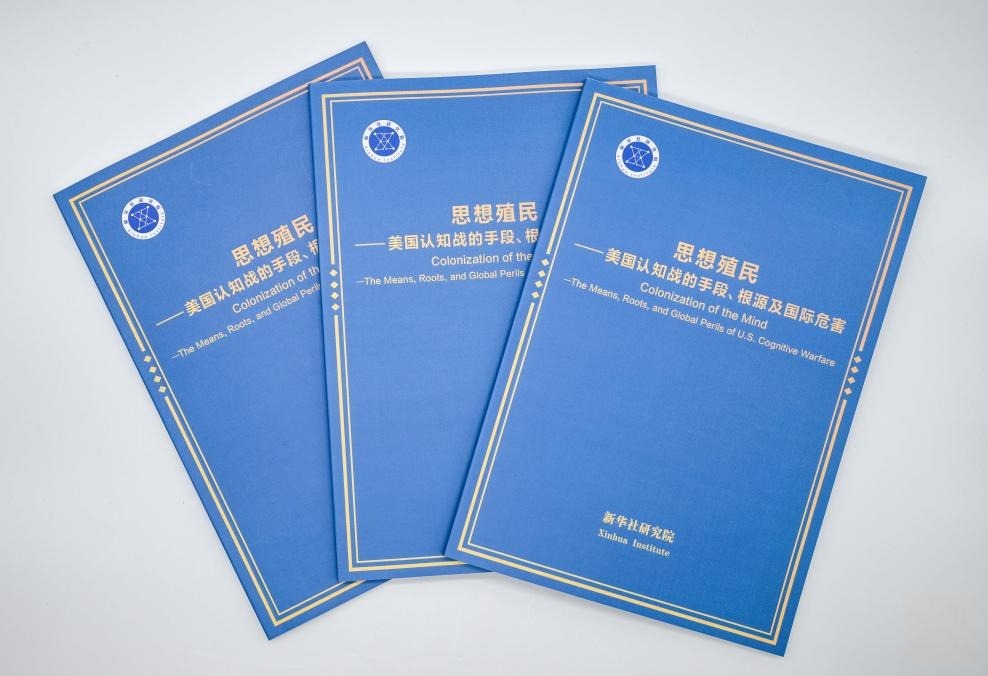
THE think tank - Xinhua Institute of China recently launched a book on the ‘Colonization of the Mind - The Means, Roots, and Global Perils of US Cognitive Warfare’ in September 2025.
The first chapter of the book describes the historical facts of how US colonize the minds of the world population. The second chapter deals with the modus operandi of how it is done. The third chapter highlights why this is extremely perilous to nations across the world. The book concluded by briefly describing how each country and its citizens could break these shackles of mind colonization.
This book itself, while some might call propaganda, is an interesting read as most of the facts, actions, strategies and intended results mentioned turned out to be extremely reflective of what has happened in the recent past years in Myanmar.
Chapter I
In terms of the forms of mind control or colonisation, there may be compulsory transformation, where the smaller and weaker countries are implanted with the US values and concepts. Or, malicious manipulation, where the US often cast aside morality and culture, to cultivate obedience and dependent factions of its target population. Next, they may tempt covert infiltration, where their ideologies and culture are exported as advanced concepts through cultural products, education, exchanges and hidden channels. The last option was long-term erosion of the target country's culture and minds via sustained infiltration, to achieve the goal of mental remoulding and perceptual reshaping.
In this context, it all begins when the US expands on the North American continent. Using the Monroe Doctrine, the US incorporated Latin America on US’s sphere of influence, under the banners of ‘opposing European interference’ and ‘America for the Americans’. But the world only became the real target after the US ascended into the position of a global leader, after WWII. During the US-USSR confrontation period, the former coined phrases such as “Free World”, “Marshall Plan” and “World Leadership”.
In the late 20th to early 21st century, the US created the ‘Washington Consensus’ to counter the world socialist movement. After the 11 September attacks, it took counter terrorism, the war on terror, the freedom agenda and democracy expansion to further enhance mind colonisation centring on American-style democracy and liberty.
At present, the US has upgraded its mind colonisation through Obama’s “Smart Power Diplomacy” to Biden’s “Diplomacy Summit” to Trump’s “America First” and “Make America Great Again” to programme the world into thinking that the US is always at the top and always be the ideological leader. Using its NSA agency, it manipulates information flows and social media to dominate global perception shaping through pretexts such as ‘Countering misinformation’ and ‘Countering foreign influence’.
The results of years of successive and successful conditioning are such that the perception of the people in poorer countries develops in such a way that the US is thought of as the leader, having the best system in the world, and the rest of the countries are inferior. Even during the times of upheaval in 2021, the Myanmar people took whatever the US said to heart and thought that the US would come and rescue them to bring them up to the heavens of democracy. When the dust settled, only donation collectors such as Pan Cel Lo, a big-time looter, ended up becoming multi-millionaires in the US. At least the US did help, yes, to help people like them cheat the general population and the Myanmar diaspora of their hard-earned cash.
The book mentioned about delivery methods of such propaganda, where the US wears white, black or grey masks at different times.
For the mind colonisation to happen, the US has to continuously push English as the ‘world’s language’ to augment its propaganda. It also systematically glorifies itself through artificial binaries such as ‘democracy versus dictatorship’, ‘freedom versus authoritarian’, ‘market versus controlled’ and ‘counter terrorism versus state-sponsored terrorism’. Through the control of digital platforms such as Facebook, YouTube and X, it seizes the high ground of communication and manipulates the algorithms. No one would doubt that Facebook played a critical role in the civil conflicts within Myanmar after the downfall of the NLD through voting fraud. And by monopolizing the knowledge production standards, through having top-notch universities on land, knowledge standards are Americanized to the extent of rejecting knowledge from non-Western countries.
The book highlighted three key motivations behind this whole exercise: to consolidate cultural hegemony, to strengthen its political power and finally to protect its economic privileges.
Chapter II
As mentioned previously, this chapter covers the modus operandi of mind colonization. In terms of strategic systems, the book categorized strategies into media and propaganda warfare, information warfare, ideological warfare and cognition warfare. With the government providing leadership through its state agencies, social collaboration via NGOs and think tanks, and collaboration with allies, e.g., Five Eyes countries, how could weaker countries stand a chance in fighting back?
Another approach that the US used, according to the book, is rephrasing its values as universal values for deception. Democracy, freedom, equality, human rights are only defined by the US based on its own perspective. The famous American dream is the one that everyone in the world should aspire to be, not the Chinese dream or the Myanmar dream! And freedom of speech only exists in the US under the US version. The people in the other parts of the world have their mouths shut. All these narratives are made possible through giant US media organizations such as Big 4 TV stations (ABC, NBC, CBS, and Fox) that broadcast throughout the globe and through outlets such as AP, New York Times, Washington Post, etc. And they used multiple platforms, not just traditional ones, as described previously. Social media, pop culture, and Hollywood are dominated by the US and US values.
Chapter 3
As a result of these US activities, the ideologies of other countries, regardless of their good intentions, were eroded, making it significantly easier to subvert foreign governments. Just take Myanmar as an example. Even during President Thein Sein’s government time, despite many groundbreaking good deeds, people still decried, calling for change. The change was influenced by the US. Change for the worse for the country indeed!
Because of this ideological warfare, citizens develop cognitive wedges among themselves, making it a breeze to provoke demonstrations, regional conflicts and distrust. The US continued support of Kayin rebels and honourable dissidents makes it close to impossible to have long-term peace deals with EAOs in certain regions of Myanmar.
US forces impose western-style development paths, making it difficult for Myanmar to find a path of independent and autonomous development that suits its national conditions, forcing it into a development trap beyond redemption.
In culture too, the strategies and tactics of mind colonisation instil blind confidence in US culture around the world, dismantling local norms, cultures and customs. Eventually, countries broke apart after incessant stress on the differences. The former Soviet Union and Yugoslavia came to mind instantly.
The solution?
So what is the solution then? While the book provided ample evidence of historical facts on mind colonisation, elaborated on how the system works and explained the severe consequences on the other nations, it listed rather short solutions to counter these wide-reaching attacks.
It urges the countries to develop an independent mind among their leaders and citizens. Education is a huge part of this. It encourages building cultural confidence as the foundation of national strength and prosperity. Last, it recommends exchanges and mutual understanding among smaller nations as an effective instrument for inter-civilizational coexistence.
In addition to the three points stated at the end of the report, I would suggest two additional practical suggestions….
1. By having a respected group of elderly statesmen who could speak up to pinpoint corrections when a country is faced with a black swan or grey rhino event. If those in Myanmar had done that in 2021 and 2022, the country would not have fallen that deep into the abyss.
2. Having think tanks who care enough for the country that they are not afraid to speak publicly, to bring forward the culture of caring for the well-being of the nation. All those in Myanmar had stayed completely quiet during 2021 to 2023, even refusing to appear on TV to speak up for the government to quell the havoc across the nation. Why take government pay and benefits if you are unwilling to stand up for the administration?
Maybe they are only interested in waiting for invitations to get free trips overseas, perhaps.